


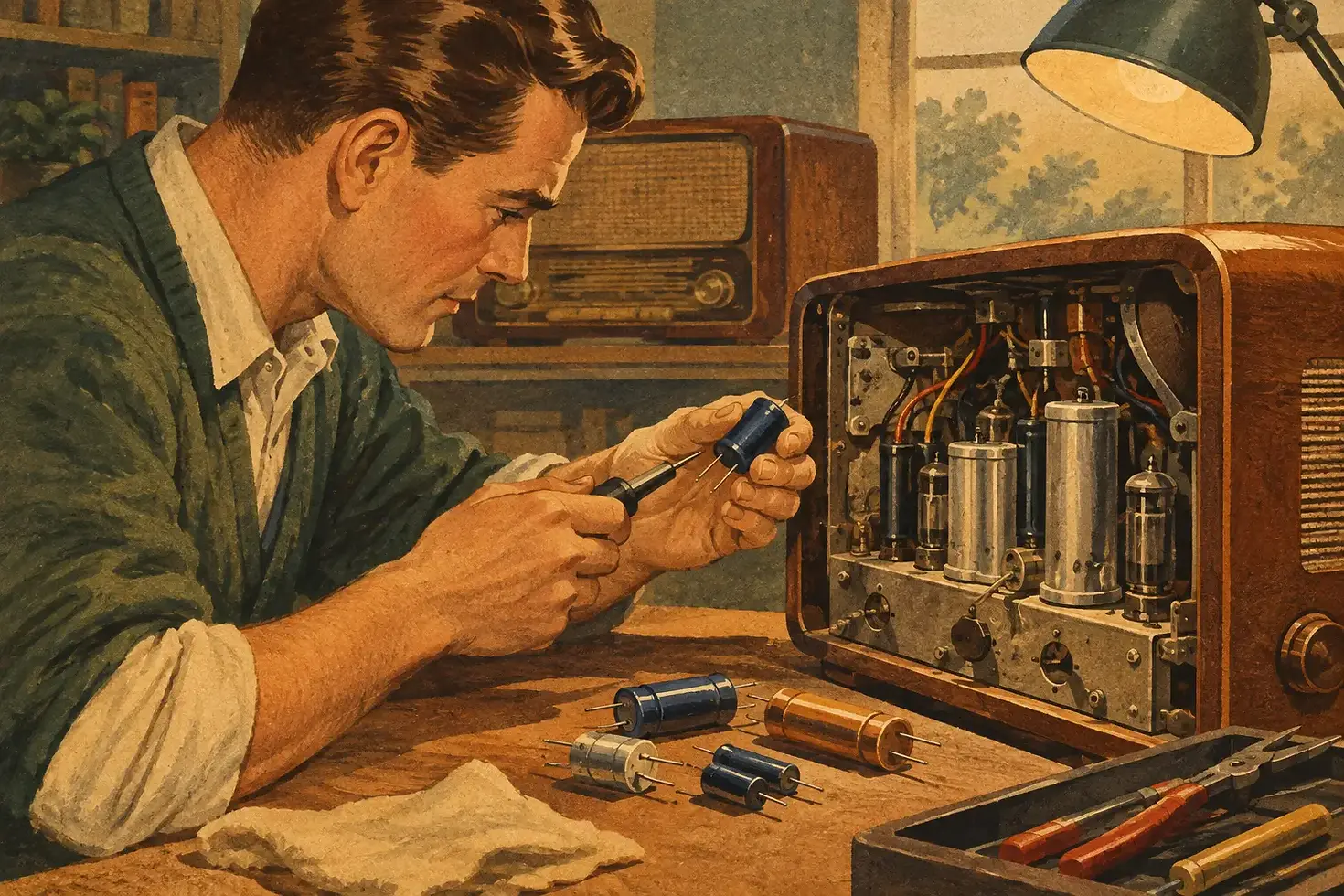
When to Replace Radio Capacitors Safely

A radio that still lights up is not necessarily a radio that is safe to play. Many antique sets can appear healthy while capacitors beneath the chassis have aged far beyond their intended service life. Knowing when to replace radio capacitors protects more than the listening experience. It can prevent damage to valuable tubes, transformers, speakers, and the irreplaceable radio itself.
For a 1930s cathedral radio, a postwar tabletop set, or the family console that has not played since childhood, capacitor work is often the foundation of a dependable restoration. The decision is not simply about changing every old-looking part. It requires an understanding of which capacitor is present, what job it performs, and how much risk its failure creates.
When to Replace Radio Capacitors in an Antique Set
If a radio has original paper or electrolytic capacitors, replacement is usually wise before regular operation, even if the set currently receives stations. These components age chemically as well as electrically. Decades of heat, humidity, storage conditions, and occasional use can cause them to become leaky, shorted, or open.
Paper capacitors, commonly wrapped in waxed paper or enclosed in cardboard tubes, are especially well known for deterioration. Their wax may look intact, but moisture can have entered the paper dielectric long ago. Once leakage develops, a capacitor can send unwanted voltage where it does not belong. In a tube radio, that may upset bias voltages, strain resistors, overheat a tube, or place a costly output transformer at risk.
Electrolytic capacitors deserve equal attention. They are often found in the power supply section, where they smooth the rectified voltage that powers the radio. When they dry out or fail, the familiar 60-cycle hum may appear. More seriously, an old electrolytic can short internally, overheat, leak electrolyte, or damage the power transformer or rectifier tube.
A radio that has been unused for decades should not be plugged in merely to see whether it works. Applying full power to original electrolytics and deteriorated paper capacitors can turn a careful restoration into a more involved repair. The cabinet may be a beautiful survivor, but the electronics still need to be treated as old electrical equipment.
Signs a Capacitor May Be Failing
Some capacitor problems announce themselves clearly. A steady hum that remains even with the volume turned down often points toward failing filter electrolytics. Weak volume, distorted sound, intermittent reception, crackling, fading after warmup, or a radio that works briefly and then quits can also trace back to capacitors.
Other warning signs are more urgent. A burning smell, smoke, excessive heat, sizzling sounds, or a fuse that blows should end any attempt to operate the radio. Turn it off, unplug it, and do not try again until the cause has been identified. Vintage radios can retain hazardous voltage after being disconnected, so opening the chassis is not a casual inspection for an inexperienced owner.
There are also failures the listener may never hear. A leaky coupling capacitor in an output stage can force a tube to draw excessive current while the radio still produces sound. The result may be a red-hot tube plate, overheated components, or transformer damage that is far more difficult to reverse than a capacitor replacement.
Age itself is therefore a meaningful symptom. In a radio from the 1920s through the 1960s, original wax-paper capacitors and original electrolytics have already exceeded the service life their makers could reasonably have expected. A quiet, working set may still need preventive electrical restoration before it is used as a daily player.
Not Every Old Capacitor Should Be Replaced Automatically
Preservation-minded restoration calls for judgment. It is not always appropriate to replace every capacitor simply because it is old. Many ceramic disc capacitors are stable and reliable. Certain mica capacitors, often used in tuned circuits, can continue to perform well for many years. Replacing stable parts unnecessarily can alter alignment, introduce new problems, or take away original material without a practical benefit.
This is particularly relevant in the RF and oscillator sections of a radio. Capacitors there can affect tracking, sensitivity, and calibration across the dial. If a component tests properly and is not associated with a known trouble pattern, leaving it in place may be the better choice.
Silver mica capacitors inside some intermediate-frequency transformer assemblies are a special case. They can develop a condition often recognized as sharp static crashes or intermittent noise. The proper repair depends on the transformer design and the radio's symptoms. This is not a situation for blanket replacement, but for diagnosis.
The goal is reliable performance without treating an antique chassis as though it were a modern circuit board. A good restoration preserves what can responsibly remain, replaces what has become unsafe or unreliable, and respects the original engineering of the set.
What a Careful Capacitor Replacement Involves
Proper capacitor service begins with identifying the circuit and verifying values, voltage ratings, and polarity where applicable. Modern replacement capacitors are generally smaller than their vintage counterparts, but smaller size does not make selection simple. The replacement must meet the electrical demands of the location, particularly in high-voltage tube circuits.
Electrolytic capacitors must be installed with correct polarity. Reversing one can cause rapid failure and potentially dangerous venting. Paper capacitors are commonly replaced with modern film capacitors, selected for suitable capacitance and voltage ratings. In safety-critical AC line locations, a restorer should use capacitors specifically designed and rated for that purpose rather than an ordinary general-use part.
Workmanship matters as much as the component choice. Leads should be neatly routed, solder joints should be secure, and original terminal strips and connection points should be preserved where practical. Excessive heat can harm fragile tube sockets, old insulation, and nearby components. A careful technician also checks associated resistors, wiring, rectifier behavior, and operating voltages, because a failed capacitor may not have failed alone.
For collectors who value an original under-chassis appearance, some restorations use restuffed capacitor shells. This approach places modern, dependable components inside the original housings where feasible. It is more time-consuming than a straightforward replacement, but it can preserve the visual character of a rare cathedral, tombstone, breadboard, or Catalin radio while making it safer to enjoy.
Replacement Versus Reforming Electrolytics
You may hear that old electrolytic capacitors can be reformed by bringing voltage up slowly. Reforming can sometimes reduce leakage in an electrolytic that has been sitting unused, and it may have a place in limited evaluation or historically sensitive work. It is not, however, a dependable substitute for replacement in a radio intended for regular listening.
An electrolytic may appear to recover during a controlled test yet fail again after hours of use. For a treasured household console or a tube receiver that will be played often, new filter capacitors provide much greater confidence. The trade-off is authenticity beneath the chassis, which is why restuffing can be worthwhile on significant or highly original pieces.
Safety Comes Before Sentiment
Antique radios carry electrical risks that deserve respect. Transformerless AC/DC sets, often called "hot chassis" radios, require particular care because their circuit design may connect one side of the power line to the chassis through components and switches. Even transformer-powered radios can contain high DC voltages capable of causing serious injury.
Do not rely on a switch being off, a cord being unplugged, or a radio seeming dead. Capacitors can hold a charge, and old insulation can fail without warning. If you are not already experienced with high-voltage tube electronics, the safest choice is to leave diagnosis and replacement to a specialist.
A restored radio should be more than a display piece that happens to make noise. It should play with stable performance, operate with appropriate safety improvements, and retain the character that made it worth saving. Whether it is a flea-market find or the radio that once sat in a grandparent's living room, thoughtful capacitor service gives those sounds of yesterday a better chance to be heard again. Regal Sound Design approaches that work as both electrical repair and careful stewardship of the history inside each cabinet.


Comments