


Why Does My Radio Fade? Vintage Set Causes

A vintage radio can sound wonderfully alive for the first few minutes, then slowly lose volume, drift into static, or disappear altogether. If you have asked, “why does my radio fade?” the answer depends on what is fading: the station itself, the audio volume, or the entire set after it warms up. Those symptoms may look similar from across the room, but they point to different parts of the radio.
For an heirloom console, a cathedral set, or a favorite tabletop radio, fading is not necessarily a sign that the piece is beyond saving. More often, it is the voice of aging components asking for careful attention. A proper diagnosis preserves both the original character of the radio and the pleasure of hearing it perform again.
Why Does My Radio Fade? Start With the Symptom
Before assuming the problem is inside the chassis, listen closely to how the fading occurs. Does one station weaken while other stations remain clear? Does the audio become softer on every station? Does the radio work normally when first switched on, then fail after ten or twenty minutes?
Reception fading usually involves the antenna, tuning section, or radio-frequency stages. Fading volume with a station still tuned in often points toward the audio circuitry, speaker, or power supply. A set that fades only after warming up may have a heat-sensitive tube, resistor, capacitor, or connection.
This distinction matters. Vintage radios were built as interconnected systems, and a quick parts swap can mask the true fault while creating new problems. Thoughtful restoration begins with observation, testing, and respect for the original design.
Weak Reception, Drifting Stations, and Interference
If the station seems to come and go, the radio may not be receiving a consistent signal. Modern homes are full of interference that did not exist when many tube radios were built. LED lamps, switching power supplies, Wi-Fi equipment, chargers, dimmer switches, and some televisions can create noise across the AM band.
Try listening with nearby electronics and lights switched off. Move the radio away from chargers, power strips, and large appliances. A portable radio may also behave differently in one room than another, especially in a steel-framed building or lower-level space.
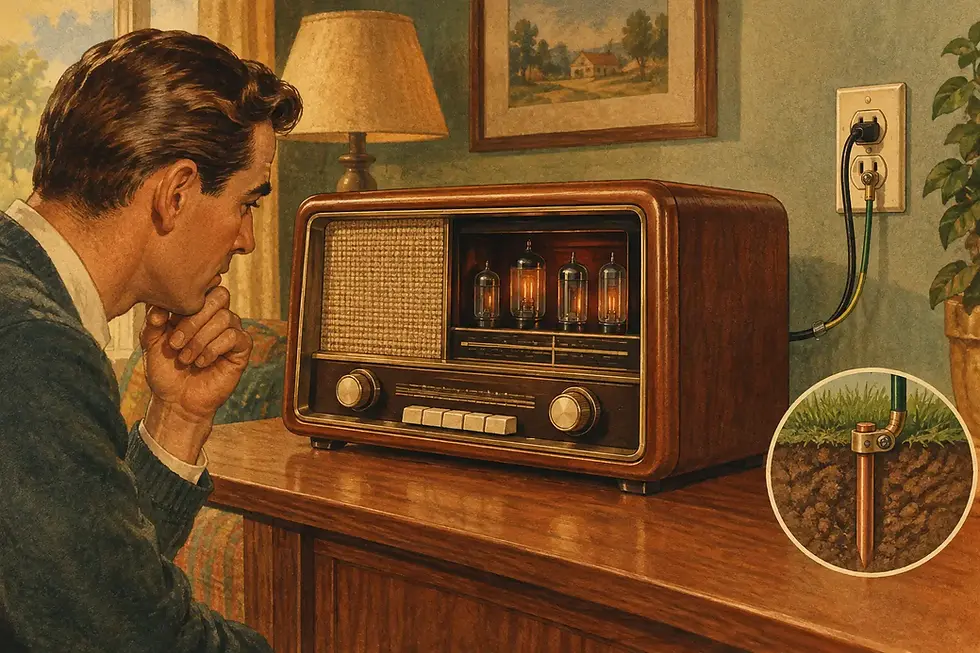
Antenna placement is equally important. Many tabletop sets use an internal loop antenna that works best when the entire cabinet is turned toward the station. Console radios and receivers may rely on a wire antenna, a built-in loop, or an external connection. A broken antenna lead, corroded terminal, or loose internal connection can make reception fade when the cabinet is moved or when temperature changes.
On an older set, the tuning capacitor is another possibility. Dust, oxidation, worn bearings, or poor grounding can affect tuning stability. If a station drifts away as the radio warms, the alignment or oscillator section may need professional evaluation. Alignment is not a casual adjustment. It requires the right test equipment, a measured approach, and an understanding of how the individual radio was designed to track across the dial.
AM Fading Can Be Normal at Certain Times
Not every fading station indicates a defective radio. AM signals can change dramatically between daylight and nighttime. During the day, distant stations may be weak or absent. After sunset, signals can travel much farther, but they may overlap with other stations and produce whistles, fading, or distortion.
Weather, local electrical noise, and the station’s own signal strength also play a role. If several radios in the same location lose the same station, the radio itself may be innocent. If only one set performs poorly while comparable radios receive clearly, it is time to inspect the set.
When the Volume Fades but the Station Remains
A radio that stays tuned to a station but becomes quieter often has a problem beyond reception. In tube radios, the most common cause is aging capacitors. These components help filter power, couple audio signals between stages, and stabilize circuit operation. Over decades, many original capacitors become electrically leaky or lose their designed value.
As the radio warms, a failing capacitor may allow circuit voltages to shift. The result can be weak, thin, distorted, or fading sound. In some cases, the radio may recover briefly after being switched off, only to repeat the problem on the next listening session.
Weak tubes can also cause gradual loss of performance. A tube may test marginally, develop internal leakage as it heats, or lose emission after a few minutes of operation. However, tubes should not be blamed automatically. Replacing tubes without addressing deteriorated capacitors, out-of-tolerance resistors, or poor connections is rarely a complete repair.
The speaker deserves attention as well. Vintage speakers use paper cones, voice coils, field coils, transformers, and wiring that may be nearly a century old. A failing output transformer, damaged voice coil, or loose connection can cause sound to fade or break up. A hum that grows louder as volume drops may indicate power-supply trouble rather than a speaker issue.
Heat Reveals Problems Hidden at Startup
Many antique radios appear healthy when first turned on. Then the cabinet warms, the tubes reach operating temperature, and a weak component begins to fail. Heat-related symptoms are especially common in radios that have sat unused for years.
Old solder joints can become intermittent. Resistors can change value. Tube sockets may develop oxidation that interrupts contact as metal expands. Coils and transformers can reveal internal weaknesses only after current has flowed for a while. These are the kinds of issues that reward patient bench testing rather than guesswork.
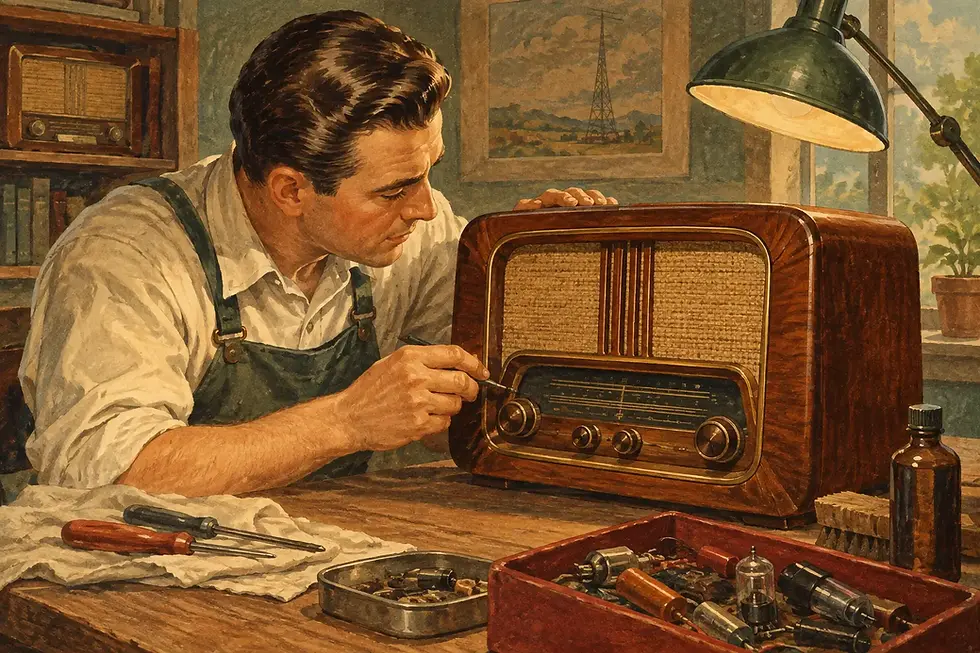
A restorer may use controlled heat and cooling methods, voltage measurements, signal tracing, and tube testing to locate the stage where the signal is being lost. The goal is not simply to make sound return for a moment. It is to identify why the set changed behavior and correct the cause in a durable, sympathetic way.
Do Not Keep Running a Fading Vintage Radio Unchecked
A fading radio is not always dangerous, but it should not be ignored. If you smell hot wax, see smoke, hear crackling, or notice an unusual hum, switch the set off and unplug it. The same applies if the radio has an original power cord with brittle insulation, a loose plug, or visible fraying.
Tube radios contain high voltages that can remain stored in capacitors even after the set is unplugged. A radio that seems small and harmless on a shelf can still carry a serious shock hazard inside the chassis. For that reason, cabinet cleaning and gentle exterior inspection are sensible owner tasks, while internal electrical work belongs with someone equipped to service tube-era electronics safely.
There is also a preservation reason to avoid repeated operation. A failing capacitor can place stress on a transformer, rectifier tube, or other harder-to-replace part. Protecting the original transformer, dial assembly, speaker, and cabinet is often more valuable than squeezing out one more evening of uncertain listening.
What a Careful Restoration Looks For
A proper evaluation considers the entire radio, not just the complaint. The power supply is inspected for safe, stable operation. Capacitors and resistors are tested or replaced where needed. Tubes, sockets, wiring, switches, controls, coils, transformers, and speaker components are checked in context.
Controls may be cleaned when appropriate, but cleaner is not a cure-all. A scratchy volume control can improve with service, while a radio that fades after warming may require deeper electrical diagnosis. Likewise, an alignment may restore sensitivity, but it cannot compensate for unstable power supply voltages or failing audio components.
For collectible radios, preservation-minded work also considers appearance. Original knobs, dial scales, chassis markings, cabinet finishes, and speaker cloth are part of the object’s history. The best repair approach balances dependable performance with restraint, replacing what must be replaced while respecting what has survived.
Regal Sound Design approaches antique radios and tube audio equipment with that balance in mind. Whether the set is a family console, an Art Deco table radio, or a carefully collected receiver, its sound and its story deserve the same patient care.
A Fading Radio Still Has Something to Say
Keep a simple record of when the fading happens: immediately or after warm-up, on one station or all stations, at a particular volume, or only in one room. Those details can shorten diagnosis considerably and help distinguish a signal problem from an internal fault.
Most of all, resist the temptation to judge a vintage radio by the standards of a modern appliance. Its fading voice may be inconvenient, but it is often a specific, repairable message from a piece of history that has been waiting a long time to be heard clearly again.

Comments