


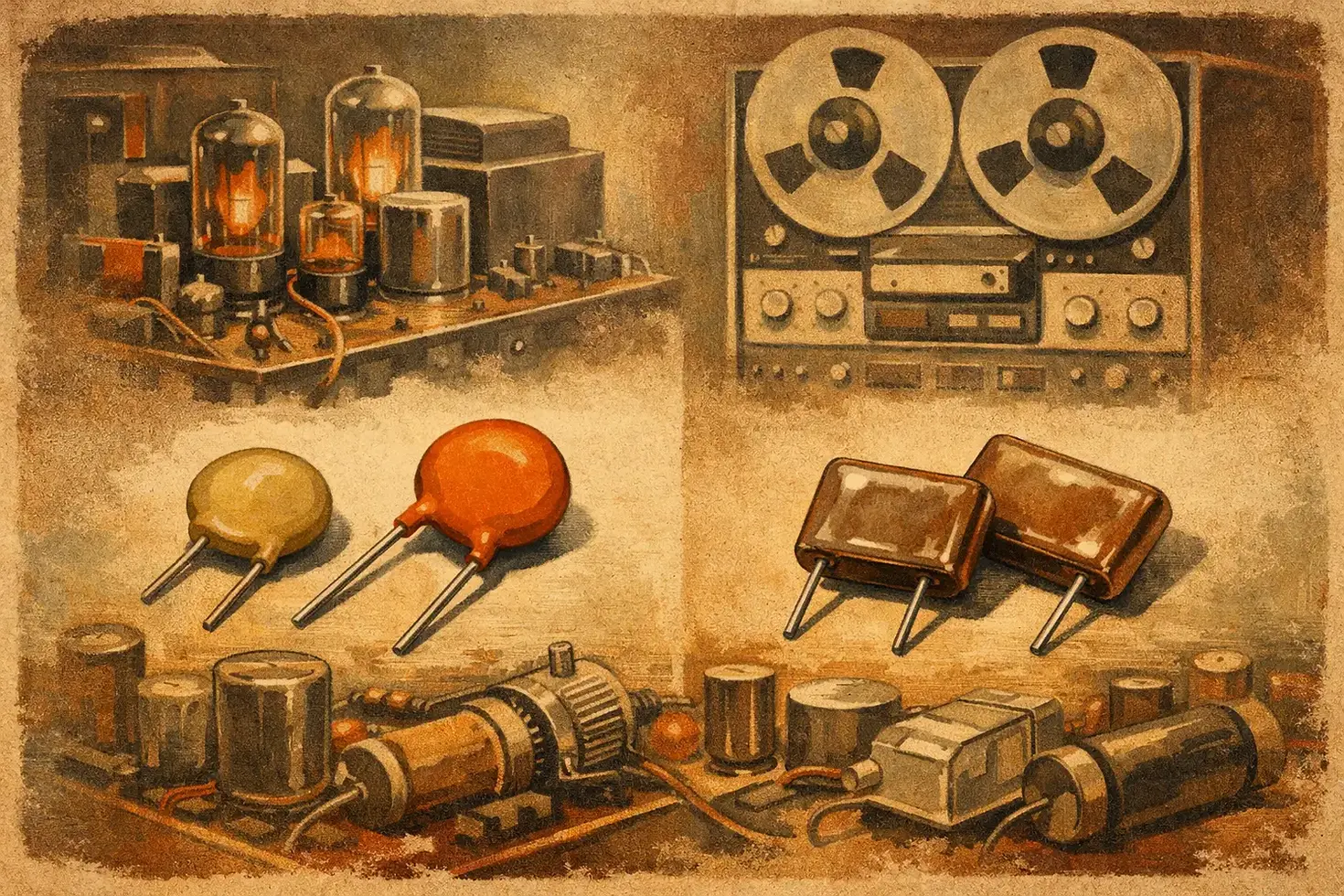
Ceramic Versus Mica Capacitors in Vintage Gear

A small capacitor can decide whether a 1940s tabletop radio tracks a station cleanly, whether a tube amplifier remains quiet at idle, or whether a treasured console sounds like itself again. The question of ceramic versus mica capacitors comes up often during restoration, but the right answer is rarely found by choosing one material for the entire chassis. It comes from understanding what that individual part is asked to do.
In vintage electronics, capacitors are not interchangeable just because their marked value is the same. Their construction affects stability, loss, temperature behavior, voltage handling, and sometimes the character of a circuit's response. Just as importantly, a conscientious restoration considers whether an original component is still dependable, historically meaningful, and appropriate to retain.
Ceramic Versus Mica Capacitors: The Essential Difference
Mica capacitors use thin sheets of mica, a naturally stable mineral dielectric, between conductive layers. Traditional molded mica capacitors and silver mica capacitors earned their place in radio-frequency work because they hold their capacitance exceptionally well over time and temperature. They are commonly found in oscillator, antenna, RF, and intermediate-frequency circuits, where a minor change in capacitance can throw alignment off or affect performance.
Ceramic capacitors use a ceramic dielectric. This is a broad family rather than one single type. A modern Class 1 ceramic capacitor, often marked C0G or NP0, is highly stable and can be an excellent choice for precision RF and timing duties. Other ceramic types, such as X7R, X5R, or older high-k disc ceramics, can vary significantly with temperature, applied voltage, and age. They are useful in many positions, but they are not automatically a substitute for mica in a sensitive tuned circuit.
The material alone does not tell the whole story. A 100 pF capacitor in the local oscillator section of a tube radio has a very different job from a 0.01 µF capacitor used to bypass a supply line. The first may need excellent stability. The second may prioritize voltage rating, low impedance at higher frequencies, and physical fit. Good restoration begins with circuit function, not with a blanket rule.
Where Mica Capacitors Belong in Vintage Radios
Mica capacitors are especially at home in low-value capacitance positions, generally in the picofarad range, where frequency stability matters. In a cathedral radio or a postwar AM receiver, they may appear around the tuning gang, RF coils, oscillator coil, or IF transformer circuits. In tube tuners and receivers, mica parts can also be found in discriminator, filter, and alignment-sensitive networks.
A healthy mica capacitor is often best left in place. Unlike wax-paper capacitors, which have a well-earned reputation for moisture absorption and leakage, many original mica capacitors remain electrically sound after decades. Replacing every mica capacitor as a matter of routine can introduce unnecessary disturbance to an original circuit and may require alignment work afterward.
That said, mica capacitors are not immortal. A receiver that crackles, pops, or drifts only after it warms up may have a suspect mica component. Silver mica disease is a familiar problem in certain IF transformers, where silver migration inside the transformer assembly creates intermittent noise and leakage paths. In that case, the remedy is not simply to install a random capacitor nearby. The transformer must be evaluated carefully, and replacement capacitors must match the needed values and be installed with attention to the original circuit layout.
Some older molded mica capacitors can also become leaky, particularly when subjected to high voltage or humid storage. Testing should guide the decision. If a mica capacitor measures correctly, remains stable under appropriate test conditions, and occupies a critical tuned position, preservation is often the more respectful choice.
When Ceramic Capacitors Are the Better Choice
Ceramic capacitors are common in later vintage equipment and can serve very well in replacement work, provided the correct grade is selected. For low-value RF capacitors, C0G/NP0 ceramic parts are usually the ceramic type worth seeking. Their low temperature coefficient and good stability make them suitable modern alternatives where a mica capacitor must be replaced and an appropriate silver mica part is unavailable or impractical.
Ceramic capacitors can also be effective for bypassing and decoupling duties. In a tube amplifier, a small ceramic capacitor may be used to control high-frequency noise or prevent oscillation. In these positions, the capacitance does not always need to remain as exact as it would in an oscillator or tuned IF stage. Still, voltage rating matters greatly in tube-era equipment. Plate, screen, and line-connected areas can expose a component to voltages far beyond what a casual hobby replacement might tolerate.
The caution is that not all ceramic discs behave alike. High-k ceramic capacitors can shift value with heat, voltage, or time. In an audio signal path, some restorers also prefer to avoid them where their nonlinear behavior could be undesirable, particularly in carefully voiced hi-fi equipment. That does not mean every ceramic capacitor harms sound. It means component selection should respect the job at hand rather than follow a one-size-fits-all parts list.
Stability Matters More Than Appearance
Vintage radios and tube components invite a natural desire to preserve what the eye sees beneath the chassis. That instinct is valuable, but cosmetic originality should never outweigh electrical safety or reliable operation. A failed capacitor can damage a power transformer, stress a rare tube, or make an otherwise restorable set unsafe to operate.
At the same time, bright modern parts placed indiscriminately in a historically significant chassis can erase some of its story. Preservation-minded work finds a balance. Components that are stable, safe, and central to original circuit behavior may remain. Components known to fail, including wax-paper capacitors and many aging electrolytics, are generally replaced with carefully chosen modern equivalents. In highly visible restoration work, replacement parts can sometimes be positioned discreetly or original shells can be restuffed when appropriate.
This is why capacitor replacement is not merely a shopping exercise. Lead dress, grounding points, capacitance tolerance, and physical location can all affect a high-gain tube circuit. A replacement installed with longer leads or routed differently may invite hum or oscillation, even when its printed value is correct.
Choosing the Right Replacement for the Circuit
Before selecting mica or ceramic, identify the capacitor's function from the schematic and verify its actual location in the chassis. Is it part of a tuned circuit? Is it coupling an audio signal, bypassing a cathode resistor, suppressing RF noise, or filtering a power supply? The answer sets the requirements.
For a precision RF or oscillator location, a good silver mica or C0G/NP0 ceramic capacitor is usually the sensible direction. For an IF transformer repair affected by silver mica disease, stable replacement capacitors are selected to match the original circuit values as closely as possible, followed by proper alignment. For general bypassing, ceramic may be entirely suitable, though film capacitors are also frequently preferred in many tube-radio and audio applications.
Voltage rating should meet or exceed the original specification, with thoughtful margin where the circuit calls for it. Do not assume that a low working voltage is acceptable simply because a capacitor is physically small. Likewise, do not substitute a dramatically different value in a tuned circuit and expect the radio to compensate. A few picofarads can matter.
When working on an heirloom radio, a Catalin set, a tube preamplifier, or a cherished family console, it is also wise to document what was changed. Photographs, retained original parts, and service notes preserve useful history for the next caretaker. At Regal Sound Design, that careful record of what belongs in a chassis is part of treating a piece of vintage electronics as more than an appliance.
The Best Choice Is Usually a Specific One
Mica remains the classic choice where exceptional stability and low loss are central to radio-frequency performance. Ceramic can be equally appropriate when it is the right class of ceramic and the circuit does not demand characteristics beyond what it can provide. Neither is universally better, and neither should be replaced solely because it looks old.
The most satisfying restoration is the one that lets a radio receive clearly, a tuner hold its station, or a tube amplifier play music with confidence while preserving as much of its original character as safety and reliability allow. Each carefully chosen capacitor helps carry that sound, and its history, forward.


Comments