


Tube Radios: What Careful Restoration Preserves

A radio that has been silent for decades can still hold a room. Perhaps it sat on a grandparent's kitchen counter, played ball games in a family den, or arrived home from an estate sale with its original finish, dial glass, and cord intact. Tube radios are more than old electronics. They are working artifacts from an era when furniture, circuitry, and sound were made to last.
Restoring one properly is not the same as making it turn on. A radio may light up, hum, or even receive a station while carrying faults that threaten the set, its cabinet, or the person operating it. Careful work respects both sides of the object: the engineering inside and the history visible on the outside.
Why Tube Radios Still Matter
From early battery sets and breadboards of the 1920s to handsome cathedral, tombstone, console, and Art Deco radios of the 1930s and 1940s, tube-era receivers reflect changing American life. Their cabinets were often built from real wood, their dials were designed to be read across a dim room, and their components were assembled with a level of serviceability rarely found in modern electronics.
The appeal is not only visual. Tube circuitry has a presence that many listeners recognize immediately: a soft warm-up, the glow behind the dial, and a fuller, more dimensional character from an AM broadcast or period-appropriate source. A well-restored set can make old radio programming, big-band recordings, baseball broadcasts, and spoken voices feel remarkably immediate.
Still, no two radios deserve exactly the same approach. A common tabletop set may be a candidate for dependable everyday listening. A scarce Catalin radio, an unusually complete cathedral, or a family heirloom may call for a more conservative restoration that protects original materials wherever possible. The right balance depends on rarity, condition, intended use, and personal meaning.
What Happens Inside Aging Tube Radios
Time is hard on electronics, even when a radio has spent years safely stored. The components that allowed a set to operate when new do not remain unchanged simply because the cabinet looks clean.
Paper and electrolytic capacitors are among the most common concerns. Their electrical values can drift or fail, causing hum, weak reception, distorted audio, overheating, or damage to other components. Old rubber or cloth-covered wire can become brittle. Resistors may change value. Tube sockets, switches, controls, and tuning mechanisms can collect oxidation and dirt that interfere with reliable operation.
There are also hazards that cannot be seen from the front of the radio. Some designs place one side of the power line directly on the chassis. Others retain high voltage long after being unplugged. A cracked cord, a failing transformer, or a poorly executed previous repair can turn a cherished find into a serious safety concern.
That is why the first test should not be to plug it in and see what happens. For a radio that has not been professionally evaluated, applying full power can place stress on aging capacitors and transformers. The fact that a dial lamp lights is not proof that the radio is safe or healthy.
Restoration Means More Than Replacing Parts
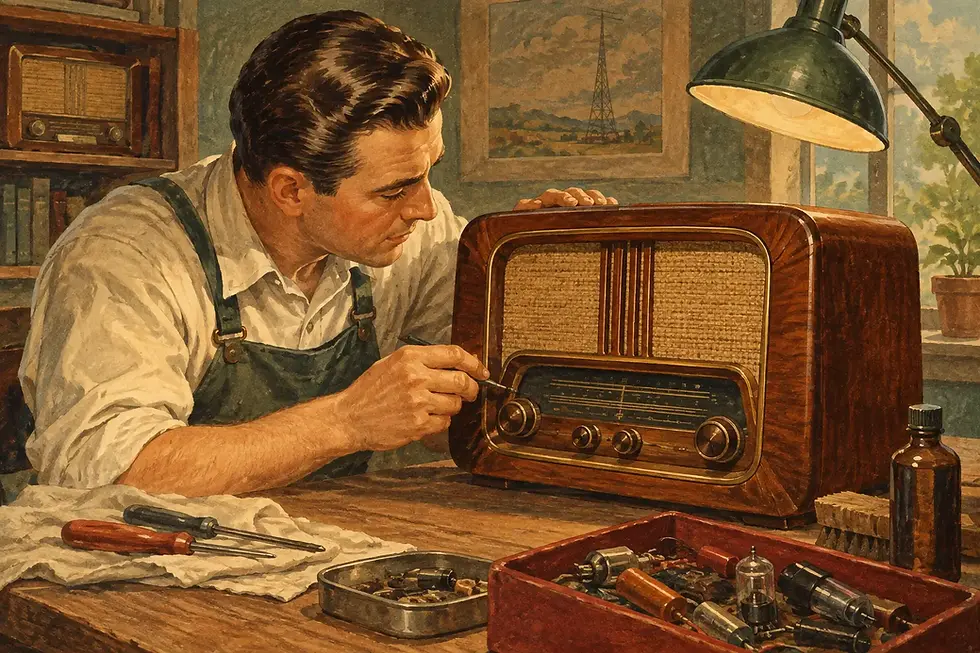
A conscientious restoration begins with inspection. The technician identifies the model, studies the circuit, examines earlier repairs, and assesses the cabinet and mechanical condition before deciding what work is appropriate. This establishes a path that serves the radio rather than applying a one-size-fits-all repair.
Electrical restoration commonly addresses failed capacitors, out-of-tolerance resistors, unsafe power cords, damaged wiring, weak or faulty tubes, and dirty controls. Alignment may follow, bringing the tuner back toward proper sensitivity and accuracy. The goal is stable, enjoyable performance without needlessly altering original design features.
Preservation-minded work also considers how replacement components are installed. Modern safety and reliability improvements can often be made discreetly, keeping the under-chassis appearance orderly and respecting the original layout. Original parts with historical value may be retained when practical, particularly in rare or highly collectible pieces. At the same time, originality should not be used as a reason to leave a radio electrically unsafe for regular operation.
Cabinet work deserves the same restraint. A cabinet with light wear, a mellow finish, and the marks of an honest life may not need to be stripped and made to look newly manufactured. Cleaning, careful stabilization, veneer repair, grille cloth replacement, and selective finish work can preserve character that a complete refinish would erase. Severe water damage, missing veneer, or failed finish may justify more extensive cosmetic restoration, but that decision should be made deliberately.
Sound Quality Is Part of the Preservation
A radio's speaker, output transformer, and audio section shape the experience as much as its dial and cabinet do. A torn speaker cone may be repairable. A distorted output stage may need diagnosis beyond a simple tube substitution. Controls should operate smoothly, tuning should track predictably, and background hum should be addressed rather than accepted as the price of owning vintage equipment.
The desired result is not a modern hi-fi system hidden inside an antique shell. It is the radio sounding as capable as its original design allows. A small five-tube tabletop radio will not deliver the room-filling bass of a large console, and a 1930s broadcast receiver will not behave like a contemporary digital tuner. Respecting those limits is part of hearing the set honestly.
Choosing the Right Level of Work
Owners often ask whether a radio should be restored, repaired, or left untouched. There is no single answer. A radio intended for daily use needs a greater degree of electrical reliability than a display-only collector piece. A common set may be restored for practical enjoyment, while an exceptionally rare model may benefit from a lighter hand.
It helps to decide what you want from the radio before work begins. Do you want to listen to local AM stations? Use a discreet external audio connection? Preserve the cabinet exactly as it was found? Display it safely without operation? These choices influence the repair plan and help avoid surprises later.
A proper specialist should be comfortable discussing trade-offs plainly. Replacing every visible original component may not be appropriate, but leaving known failure-prone parts in service rarely serves the owner or the radio. Refinishing can renew a damaged cabinet, but it can also reduce collector appeal if the original finish was largely intact. Thoughtful restoration is careful judgment, not automatic replacement or automatic preservation.
Care After the Radio Comes Home
Once restored, tube radios benefit from reasonable habits. Keep the set dry, away from direct heat and strong sunlight, and allow ventilation around the cabinet. Do not cover vents or operate the radio unattended for long periods. If you notice a new burning odor, loud hum, crackling, fading reception, or excessive heat, turn it off and have it evaluated.
Use the controls gently. A stiff tuning dial or frozen knob should not be forced. Avoid storing radios in basements, attics, garages, or other places with wide swings in temperature and humidity. For consoles and larger cabinets, protect the finish from drink rings, plants, and cleaning products that can cloud lacquer or damage veneer.
Most importantly, resist the urge to treat an antique radio as a casual project if you are unfamiliar with high-voltage tube equipment. There is satisfaction in learning about vintage electronics, but there is also real risk. Experienced service preserves the radio while giving its owner confidence that it can be enjoyed responsibly.
A Familiar Voice, Heard Again
The best restored radio does not lose its age. Its cabinet still bears the design language of its time. Its dial still glows with the same promise of distant stations. Its sound still carries the character of the period in which it was built.
At Regal Sound Design, restoration is approached as stewardship: careful attention to tube-era circuitry, respectful handling of original materials, and a commitment to bringing meaningful equipment back to life. Whether the radio is a modest tabletop find or a long-kept family console, its value often grows the moment it fills a quiet room with sound again.
If a silent radio has been waiting in your home, let its condition and history guide the next step. With patient, knowledgeable care, it can remain more than a beautiful object - it can become part of the household once more.


Comments