


Repair Versus Restoration for Vintage Audio Gear

A 1940s tabletop radio that hums but still receives a station is not necessarily asking for the same work as a silent family console that has spent decades in an attic. The question of repair versus restoration is more than a choice of words. It determines what happens to the circuitry, cabinet, finish, original components, and character that made the piece worth keeping.
For antique radio collectors, vintage hi-fi owners, and families entrusted with an heirloom, the right decision begins with a simple truth: old electronics can be historically significant and electrically unsafe at the same time. A thoughtful service approach must respect both facts.
Repair Versus Restoration: The Essential Difference
A repair addresses a specific fault. Perhaps a tube amplifier has lost one channel, a turntable will not hold speed, or an AM radio produces only a loud hum. The technician diagnoses the failure and corrects what is needed to return the unit to operation. The goal is focused function.
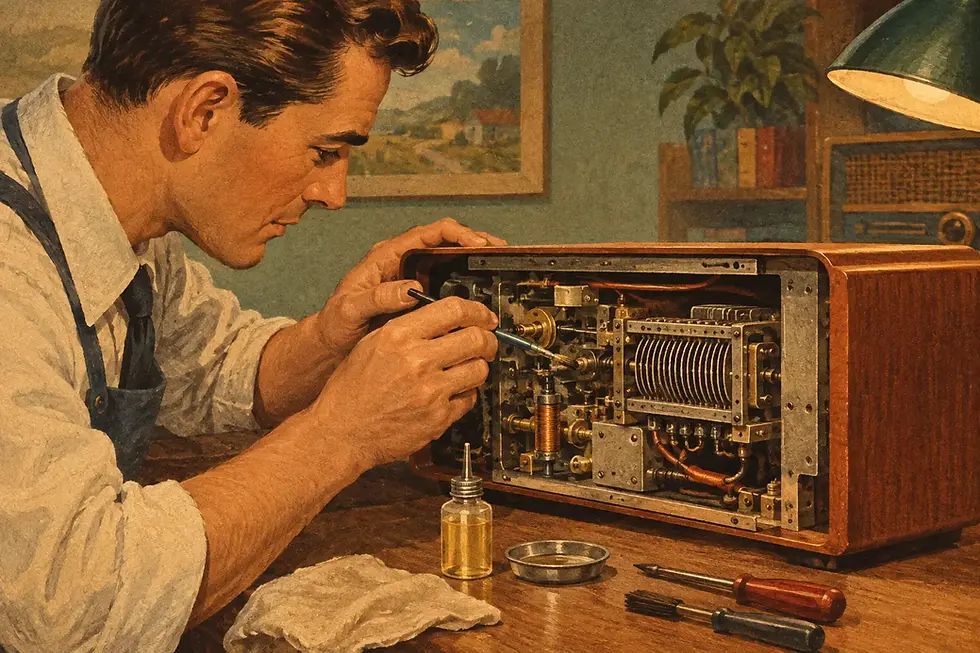
Restoration is broader. It is a careful process of returning a piece closer to reliable, appropriate performance while preserving its historical identity. That may involve replacing aged capacitors and deteriorated wiring, testing tubes, aligning radio circuits, cleaning controls, addressing mechanical wear, and evaluating the cabinet without casually erasing its age.
Neither service is automatically better. A small, isolated issue in an otherwise recently serviced tube tuner may call for a repair. A 1930s cathedral radio with untouched original electronics, brittle rubber wiring, and decades-old capacitors usually deserves a more complete restoration plan before regular use.
The distinction matters because vintage equipment does not age evenly. A radio can look beautiful while hiding electrical problems underneath the chassis. Conversely, an amplifier can have cosmetic wear that tells an honest story while performing wonderfully after careful electronic restoration.
When a Focused Repair Is the Right Choice
Repair makes sense when the scope is clear and the equipment has already received competent service. For example, a properly restored tube receiver may develop scratchy controls, a noisy tube, a failed dial lamp, or a broken tuning cord years later. Those are specific concerns, not necessarily reasons to revisit every part of the set.
A focused repair can also be appropriate for a collector who wants to preserve an original, non-operating artifact for display. Some early breadboard and battery sets, rare examples, or unusually intact pieces may carry value in their untouched condition. In those cases, the owner may prefer stabilization and limited corrective work rather than a conversion into a daily-playing radio.
Budget and intended use belong in the conversation as well. If a flea-market tabletop radio is meant for occasional display and the owner only wants an assessment of whether it can be made to play, a repair-first evaluation may be sensible. The right recommendation should follow the condition and purpose of the piece, not a one-size-fits-all package.
Still, a repair should never mean overlooking hazards. Old paper and electrolytic capacitors can fail in ways that stress expensive power transformers, rectifiers, and output tubes. Crumbling insulation, damaged cords, and improper past repairs deserve attention even when the original complaint seems minor.
What a True Restoration Usually Includes
Restoration begins with evaluation, not assumptions. Tube-era electronics from the 1920s through the 1960s vary widely in design, construction, and service needs. A battery-operated 1920s set requires a different approach from an Art Deco AC radio, a postwar console, or a stereo tube amplifier.
The electronic portion often includes replacing components known to deteriorate with age, while retaining original parts that remain dependable and meaningful to the unit's integrity. Capacitors are frequent candidates because many were never designed to perform reliably after seventy or eighty years. Resistors, wiring, switches, transformers, tubes, speakers, and mechanical assemblies are evaluated individually rather than treated as interchangeable.
Proper restoration also considers performance. A radio may need alignment so that stations track correctly across the dial and sensitivity is returned. A tube amplifier may need bias checks, quiet signal paths, stable power supply performance, and testing under normal operating conditions. A turntable may require attention to its idler wheel, motor mounts, lubrication, speed accuracy, and cartridge compatibility.
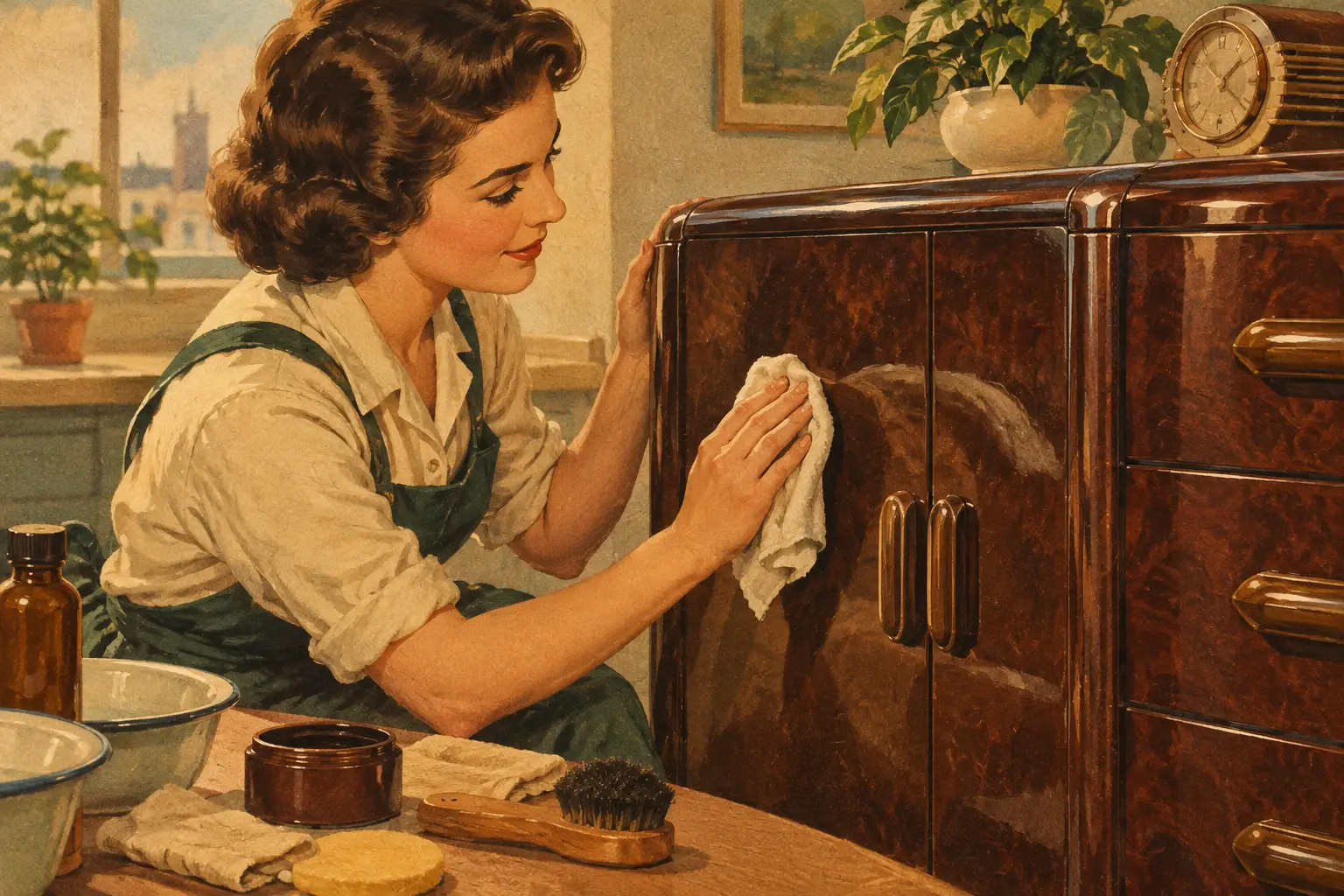
The cabinet deserves the same restraint. Original lacquer, grille cloth, dial scales, knobs, decals, and patina can be lost quickly through aggressive refinishing or cleaning. Sometimes a cabinet needs careful preservation, minor touch-up, or structural repair. Other times, water damage or a failed previous finish makes refinishing the respectful choice. The condition of the individual piece should lead the decision.
Original Does Not Always Mean Safe
Owners understandably value originality. Yet an all-original chassis is not always a virtue if it is intended to be plugged in and enjoyed. Components that were correct at the factory can become unreliable with age, and certain materials present real safety concerns.
Preservation-minded restoration does not mean leaving every old part in place regardless of condition. It means documenting, retaining, or carefully replacing what is necessary without stripping the equipment of its identity. The aim is to hear the sounds of yesterday without placing the radio, the home, or irreplaceable components at unnecessary risk.
Restored Does Not Mean Made New
A well-restored 1930s tombstone radio should not be expected to behave like a modern digital receiver. It may have a narrower tuning range, more background noise, and the gentle drift characteristic of warm tube circuitry. A vintage turntable may require more care in record and stylus selection than a current model.
That is not failure. It is part of owning historical technology. Good restoration improves dependable operation within the limits of the original design rather than promising modern features the equipment was never built to provide.
How Intended Use Changes the Answer
Before authorizing work, consider how the equipment will live after service. A console radio that will play softly on weekends in a living room has different needs from a tube preamplifier used daily in a serious listening system. A rare Catalin radio displayed as a collectible has different priorities from a common tabletop set that a family wants to hear again.
For daily listening, electrical reliability and safety tend to carry greater weight. For museum-like display, historical preservation may take precedence. For estate pieces, the best path is often a balanced one: preserve the cabinet's personality, make the chassis safe and dependable, and avoid unnecessary alteration.
This is why experienced vintage audio service is so specialized. General electronics repair may solve an immediate fault, but tube radios and legacy sound components benefit from knowledge of period circuits, common failure patterns, correct testing methods, and the value of original details. A replacement that works electrically may still be wrong for the equipment if it changes fit, appearance, performance, or future serviceability.
Questions Worth Asking Before Work Begins
A trustworthy restoration conversation should be specific. Ask whether the unit will be evaluated for electrical safety, whether aged capacitors and wiring will be addressed as needed, and how original appearance will be preserved. Ask what work is essential, what is optional, and what condition limits may remain after service.
It is also reasonable to ask how the equipment will be tested. A radio should be checked for reception and stable operation, not merely switched on long enough to confirm that sound exists. An amplifier should be evaluated for noise, channel balance, and operating condition. Clear communication protects the owner and gives the technician a proper understanding of the piece's purpose.
At Regal Sound Design, that purpose is central. A grandfather's console, a treasured tube receiver, or a newly found cathedral radio deserves more than a quick fix. It deserves careful handling and work that respects why it was saved in the first place.
The best choice is rarely about making an old piece look untouched or making it act brand-new. It is about deciding what should be preserved, what must be renewed, and how the equipment can continue speaking in its own original voice.

Comments