


A Heirloom Electronics Preservation Guide

A radio that has been quiet for decades can still carry a family voice: the console that filled a living room after supper, the cathedral set found in a grandparent's study, the tube amplifier that made a first serious record collection sound alive. An heirloom electronics preservation guide begins with one rule that can prevent a costly loss: do not plug an unknown vintage set into the wall simply to see whether it works.
Many heirloom radios and audio components appear sound on the outside while their internal materials have changed dramatically. Capacitors dry out, rubber wiring hardens, insulation cracks, lubricants turn stiff, and old power cords become unsafe. Careful preservation protects both the object and the person who hopes to hear it again.
Start With the Story, Not the Switch
Before cleaning, moving, or repairing an heirloom, record what is known about it. Photograph the cabinet, dial, chassis, labels, tube layout, speaker, and any handwritten notes or service tags. Capture wear honestly, including water marks, missing knobs, scratches, and veneer lifts. These details establish a useful record and can help a qualified restorer identify what is original.
If the piece came from an estate, ask relatives for its story. Was it used daily? Did it sit in a damp basement? Was it repaired by a neighborhood shop in the 1950s? A replacement speaker or an old service note is not necessarily a flaw. It may be part of the item's own history.
Keep model numbers, serial numbers, and loose parts together in a labeled envelope or box. A detached knob, back panel, loop antenna, tube shield, or turntable spindle can be difficult to replace later. Do not tape parts directly to the cabinet or wrap them in newsprint, which can transfer ink and trap moisture.
Safe Handling for Vintage Radios and Tube Gear
Tube-era electronics demand more caution than ordinary household objects. Even when unplugged, certain components can retain a dangerous electrical charge. Sets from the 1920s through the 1960s may also contain brittle insulation, sharp chassis edges, lead-based solder, or materials that require specialized handling.
Avoid opening the chassis unless you understand high-voltage equipment and know how to work safely around it. This is especially true of AC/DC radios, many transformerless tabletop sets, and high-powered tube amplifiers. Their appearance can be modest; their electrical hazards are not.
When moving a console radio, receiver, or large amplifier, support it from the cabinet base rather than its knobs, dial glass, speaker grille, or carrying handle. Two people are often the sensible choice. Tube glass is vulnerable to impact, and a heavy power transformer can strain a chassis that is lifted carelessly.
For temporary storage, choose a clean, stable interior space. The best conditions are boring ones: moderate temperature, moderate humidity, little direct sunlight, and no risk of leaks. Attics, garages, sheds, and basements introduce swings in heat and moisture that can warp wood, corrode metal, encourage mold, and damage dial scales.
If you are preparing several pieces for storage, these four precautions make a meaningful difference:
Keep each unit elevated off a concrete floor on shelving, blocks, or furniture pads.
Cover it with a breathable cotton sheet or clean paper, not sealed plastic.
Remove old batteries promptly from battery sets, portable radios, and accessories.
Store loose tubes, knobs, and hardware in clearly labeled containers near the unit, not inside it.
Plastic bags can be useful for a short, dry move, but they are a poor long-term solution for a cabinet that needs air circulation. A damp cabinet enclosed in plastic has little chance to dry out.
Cleaning Without Erasing the Past
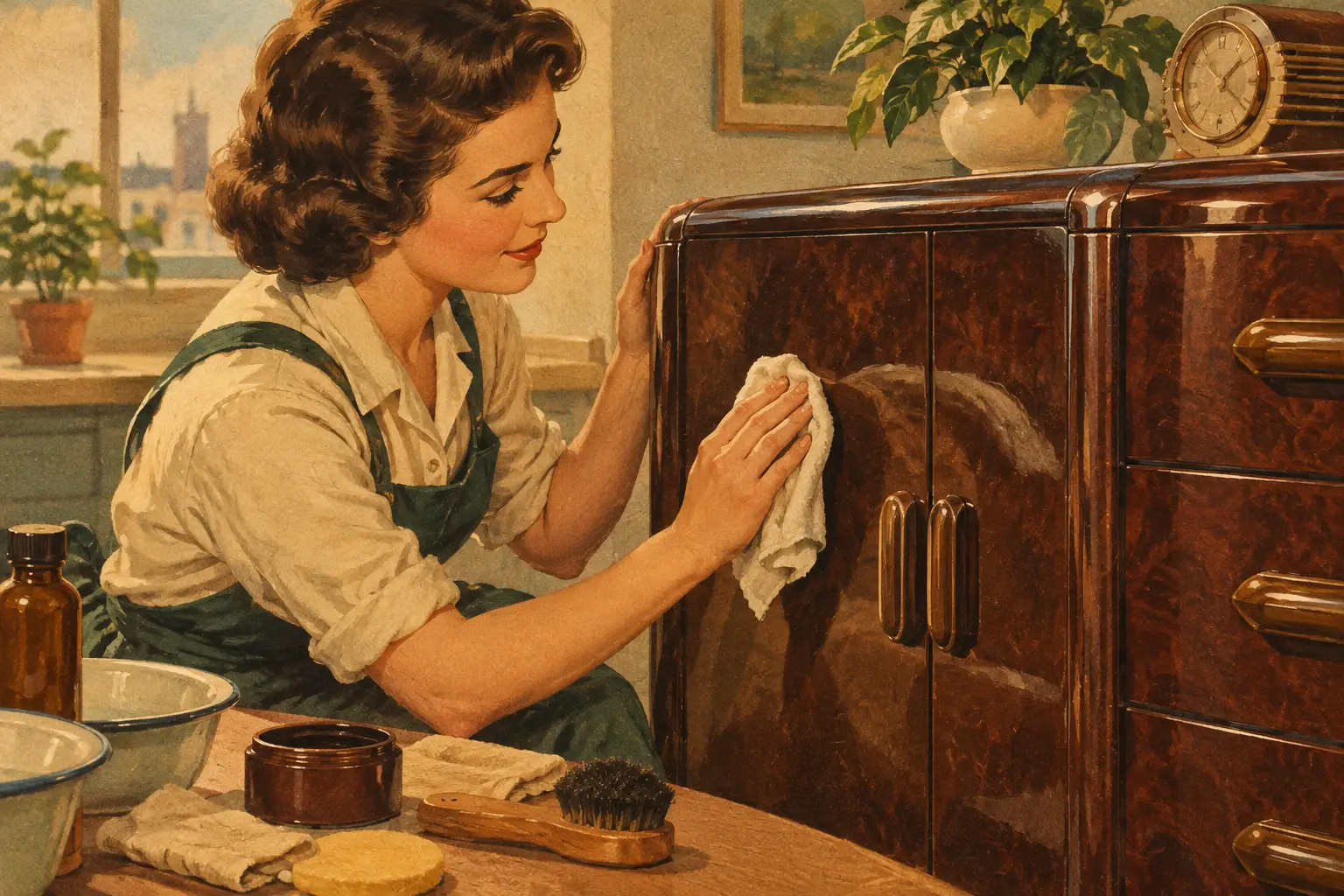
Dust is one thing. Aggressive cleaning is another. A light pass with a soft brush or microfiber cloth is generally safer than household sprays, furniture polish, window cleaner, or abrasive compounds. These products can cloud dial plastic, remove printed lettering, stain porous Bakelite, and leave a glossy finish that does not belong on an old cabinet.
Use a dry, soft brush around dial markings, grille cloth, vents, and tuning mechanisms. Vacuuming can help only when done from a distance with low suction and a brush attachment. Never drag an attachment across fragile cloth or a delicate dial face.
Cabinets require judgment. A radio with original finish, even when worn, may be more desirable and historically honest than one stripped to bare wood and refinished to look new. On the other hand, lifting veneer, active mold, severe smoke residue, and structural damage may justify professional conservation work. Preservation is not the refusal to touch an object. It is making the least destructive choice that protects its future.
Catalin, Plaskon, and other early plastics deserve particular restraint. Strong cleaners, heat, direct sun, and untested polishes can change their surface or color. Never attempt to brighten a plastic cabinet with harsh chemicals because a collector forum suggested it. Materials age differently, and a treatment that appears harmless on one set can permanently damage another.
Why Powering Up Is a Restoration Decision
The temptation to test an old radio is understandable. You want to know whether the tubes glow, whether the dial lights, whether a familiar station emerges from the speaker. Yet applying full modern line voltage to dormant electronics can damage a power transformer, rectifier, filter capacitors, speaker, or other original parts that may be difficult to replace.
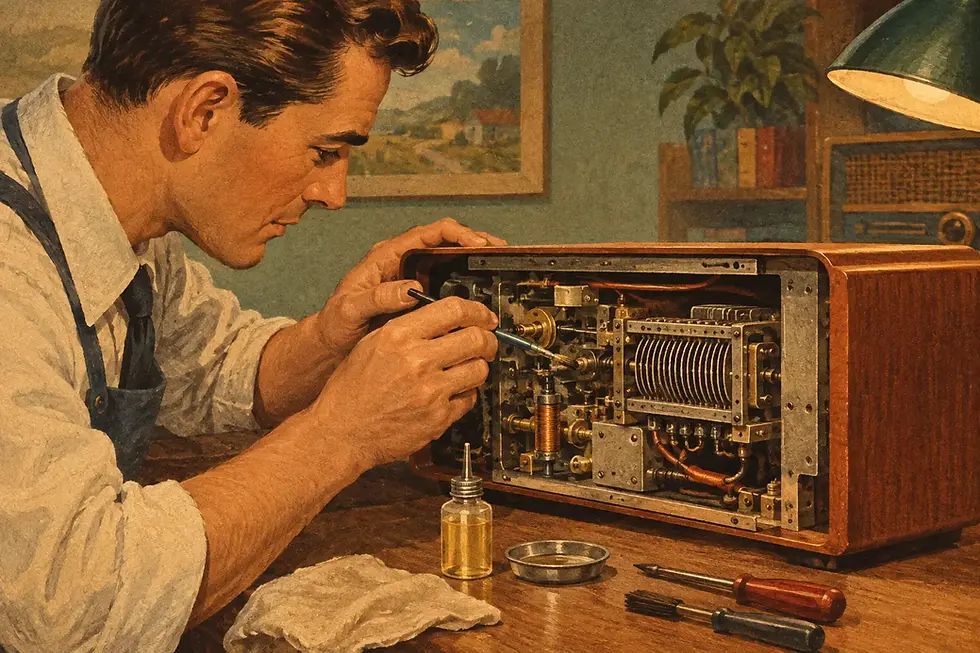
A qualified technician evaluates a set before energizing it. That usually includes a visual inspection of the chassis, wiring, power cord, fuse arrangement, tubes, controls, and components known to fail with age. Electrical testing should proceed gradually and with appropriate equipment, not through repeated attempts at the wall outlet.
Restoration also involves choices. Some owners want dependable daily operation and modern safety improvements, such as a properly grounded cord where appropriate, carefully selected replacement capacitors, and corrected wiring. Others want the unit preserved as a display piece with minimal intervention. Both goals are legitimate, but they call for different work.
The strongest restoration respects the character of the equipment while addressing the conditions that make operation unsafe or unreliable. Original knobs, dial glass, cabinet finish, speaker cloth, and tube shields are often worth saving whenever possible. Under the chassis, reliable modern replacement parts may be the responsible choice when original components have reached the end of their safe service life.
Choose a Specialist Who Understands the Era
General electronics repair experience is valuable, but antique radio and tube audio restoration is its own discipline. A 1930s cathedral radio, a 1940s Art Deco tabletop, a postwar console, and a tube preamplifier may each present different circuitry, materials, alignment requirements, and preservation concerns.
Ask a prospective restorer how they approach original finishes, obsolete components, replacement parts, and documentation. A careful specialist should be able to explain what needs replacement, what can remain, what is optional, and what will change cosmetically or functionally. Clear communication matters as much as technical skill when the object is irreplaceable.
For valuable or sentimental pieces, request photographs and a written description of the work performed. Keep those records with the radio or audio component. Future caretakers will benefit from knowing when capacitors were replaced, wiring was addressed, tubes were tested, or a turntable was serviced.
At Regal Sound Design, the purpose of restoration is not to make every piece look factory-new. It is to preserve the craftsmanship, presence, and sound that made it worth keeping in the first place.
Give a Restored Piece a Gentle Second Life
Once an heirloom is safely restored, routine care is simple. Keep it away from heat vents, sunny windows, and crowded shelves that block ventilation. Use it regularly but sensibly, especially tube equipment. A short, attended listening session is better than leaving an old amplifier or radio operating unattended for hours.
Give tubes time to warm up and cool down. Do not move a unit while it is hot. For turntables, replace worn styli and avoid playing treasured records with an unknown needle, since a damaged stylus can harm the record groove quickly.
Most of all, let the heirloom be more than a display object if its condition permits. Hearing a carefully restored radio pull in a station or a tube amplifier bring warmth and detail back to a familiar record can turn family history into something present again. With patient handling and informed repair, the next person entrusted with it may receive not just an antique, but a living piece of the past.

Comments