


Radio Restoration Versus Replacement Explained

A silent cathedral radio found in an attic is not automatically a lost cause. Neither is a console that hums, a tabletop set with a dim dial, or a tube receiver that has not played clearly in decades. Radio restoration versus replacement is a decision about more than getting music or broadcasts back into a room. It is about deciding what should be preserved, what can be safely renewed, and what place the piece holds in your home or collection.
For many owners, a vintage radio carries a family story. It may have sat in a grandparent's kitchen, welcomed holiday guests from a console cabinet, or been the first object brought home from an estate sale. A modern replacement may be convenient, but it cannot reproduce the cabinet craftsmanship, warm dial glow, or particular character of the original set. At the same time, restoration is not the right answer for every radio. The condition, rarity, intended use, and cost all deserve an honest look.
What Restoration Actually Means
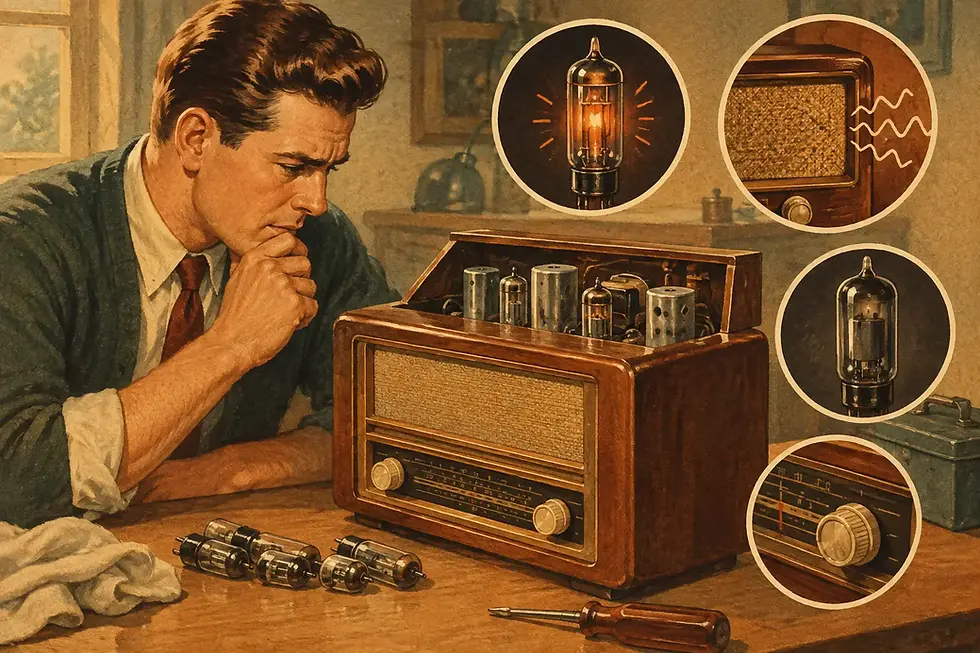
True restoration is not simply making an old radio turn on. Tube-era electronics can contain tired capacitors, weakened tubes, brittle wiring, drifted resistors, worn controls, damaged speakers, and power components that no longer operate safely. A careful service process begins with inspection, not a quick power-up. Applying current to an untouched antique set can cause additional damage and, in some cases, create a safety hazard.
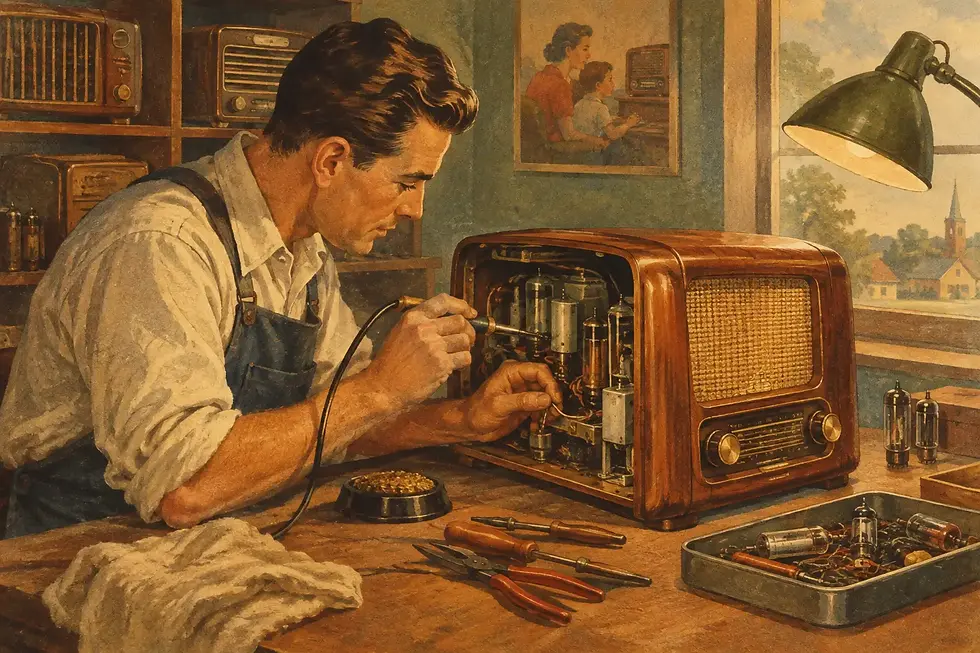
The aim is to restore dependable performance while respecting the radio's original construction. In many cases, modern replacement capacitors are installed beneath the chassis while the visible appearance is preserved. Controls are cleaned and lubricated, tubes are evaluated, alignment is performed where appropriate, and speaker or dial issues are addressed with a light hand. The result should be a radio that sounds like itself again, not a vintage cabinet hiding an unrelated modern device.
Cosmetic work calls for the same restraint. A worn finish may be part of a radio's honest history, while severe veneer loss or water damage may justify careful cabinet repair. Original grille cloth, knobs, escutcheons, decals, and dial glass matter to collectors and to the overall presence of the piece. Preservation-minded work considers what should remain untouched as carefully as what must be repaired.
When Radio Restoration Versus Replacement Favors Repair
Restoration is usually the stronger choice when the radio is structurally sound and has sentimental, historical, or collector value. A family heirloom does not need to be a rare museum piece to be worth saving. If it is the radio you remember hearing as a child, its value is personal before it is financial.
It also makes sense when the set represents a distinctive period of design or engineering. Cathedral and tombstone radios from the 1930s, colorful Catalin and Plaskon models, Art Deco tabletops, breadboard sets, and well-built mid-century consoles all reflect eras that modern equipment cannot replace. Even an unassuming five-tube table radio can be worth restoring when its cabinet, dial, and chassis remain intact.
Sound is another consideration. A properly serviced tube radio or tube receiver has a presentation that many listeners find inviting: full-bodied, immediate, and engaging. This does not mean every vintage unit will outperform modern hi-fi equipment in every respect. Frequency response, noise level, source options, and stereo separation may differ greatly from a contemporary system. Yet a well-restored set can provide an experience that is satisfying precisely because it is different.
Repair is also often preferable when a fault is limited and the underlying set is healthy. Crackling controls, a weak rectifier tube, failed capacitors, deteriorated power cords, misalignment, or a damaged speaker component can make a radio appear beyond help when the necessary work is quite manageable for a specialist. The important distinction is between a serviceable radio with age-related failures and one that has suffered extensive loss, corrosion, fire damage, or incomplete previous work.
When Replacement Is the More Sensible Choice
There are times when replacement, or a different path altogether, is practical. If your only goal is everyday streaming, Bluetooth connectivity, or high-volume sound in several rooms, a modern audio system will meet that need more directly. A vintage radio can sometimes be adapted to accept an external audio source, but that modification should be considered carefully, particularly on rare or highly original examples.
Replacement may also be appropriate when a radio has little sentimental value, extensive structural damage, and restoration costs that exceed what the owner is comfortable investing. A cabinet with severe insect damage, a badly rusted chassis, missing proprietary parts, or evidence of unsafe amateur modifications may require far more work than expected. In those cases, a specialist can help determine whether the set is a viable restoration candidate, a parts donor, or best retained as a display piece.
Financial value deserves perspective. Not every antique radio will command a high resale price after restoration. Service is often chosen because an owner wants to enjoy the radio, preserve a family object, or keep an important design intact, not because it promises a profit. A thoughtful decision recognizes both the market value and the value that cannot be listed in a price guide.
The Safety Question Should Come First
Vintage radios were built for the electrical standards of their time. A frayed cord, failing capacitor, hot chassis design, deteriorated insulation, or unstable power supply can make casual operation risky. The fact that a radio lights up does not mean it is safe to use.
This is especially true of sets that have been stored in basements, garages, barns, or attics. Moisture, heat, rodent damage, and old repair attempts can affect components hidden beneath the chassis. Before plugging in an unfamiliar tube radio, it is wise to have it assessed by someone experienced with antique electronics. A careful evaluation protects the equipment and the person who hopes to hear it play again.
A restored radio should also be used realistically. It needs ventilation, appropriate power, and reasonable operating intervals. Tube equipment generates heat by design, and its components benefit from thoughtful use rather than neglect or continuous unattended operation.
Preserve the Original Character, Not Every Failed Part
Some owners worry that replacing aged electrical parts will make a radio less authentic. Others assume every original part must be removed for the radio to be reliable. Both approaches can miss the point.
The best restoration work distinguishes between historically meaningful features and consumable components that have reached the end of their useful life. Original cabinets, dial scales, transformers, speaker assemblies, controls, labels, and chassis details often deserve preservation. Paper and electrolytic capacitors, cracked cords, and failed resistors generally do not become more valuable by remaining in unsafe or nonfunctional condition.
This balance is particularly important with collectible radios and tube audio equipment. An overly aggressive refinish, an incorrect speaker substitution, or irreversible cabinet modification can reduce appeal. On the other hand, carefully chosen service parts and reversible changes can allow the piece to be enjoyed while protecting its identity. Regal Sound Design approaches these decisions as stewardship, because each radio has both a circuit to repair and a history to respect.
Questions to Ask Before You Decide
Begin with the story of the piece. Is it a family radio, a scarce model, a favorite design, or simply an affordable entry into vintage listening? Then consider its physical condition. Are the cabinet and major components present? Has the chassis been altered? Is there corrosion, water damage, or evidence of overheating?
Next, be clear about how you want to use it. A radio intended for occasional Sunday listening has different requirements than a tube amplifier expected to anchor a daily music system. A collector may prioritize originality, while a listener may place greater value on stable operation and carefully integrated source options.
Finally, ask for a realistic assessment before authorizing major work. A qualified restoration specialist can explain what has failed, what should be preserved, what level of performance is reasonable, and where costs are likely to fall. That information replaces guesswork with a decision you can feel good about.
The right choice is not always the newest option or the most elaborate restoration. Sometimes it is a complete electrical renewal; sometimes it is respectful stabilization; sometimes it is choosing a modern companion system while keeping the original radio intact. If the piece still speaks to you when you see it sitting quietly on the shelf, it may be worth giving it the chance to speak again.

Comments