


Cathedral Radio Repair Example: A Careful Revival

A cathedral radio can arrive looking nearly complete while hiding decades of electrical decline beneath its arched cabinet. The grille cloth may be intact, the dial may still glow faintly, and the knobs may turn with the reassuring resistance of old machinery. Yet a radio that has been silent since the Eisenhower years should not simply be plugged in. This cathedral radio repair example shows what a preservation-minded revival can involve: restoring dependable performance while respecting the materials, circuitry, and history that make the set worth keeping.
For many owners, the radio is more than a 1930s appliance. It may be the set that sat in a grandparent’s kitchen, an estate find with an unusually beautiful veneer, or the first antique radio that made tube sound feel real. A proper repair should honor both sides of that story - the object and the experience of hearing it again.
The Cathedral Radio Repair Example: A Typical Starting Point
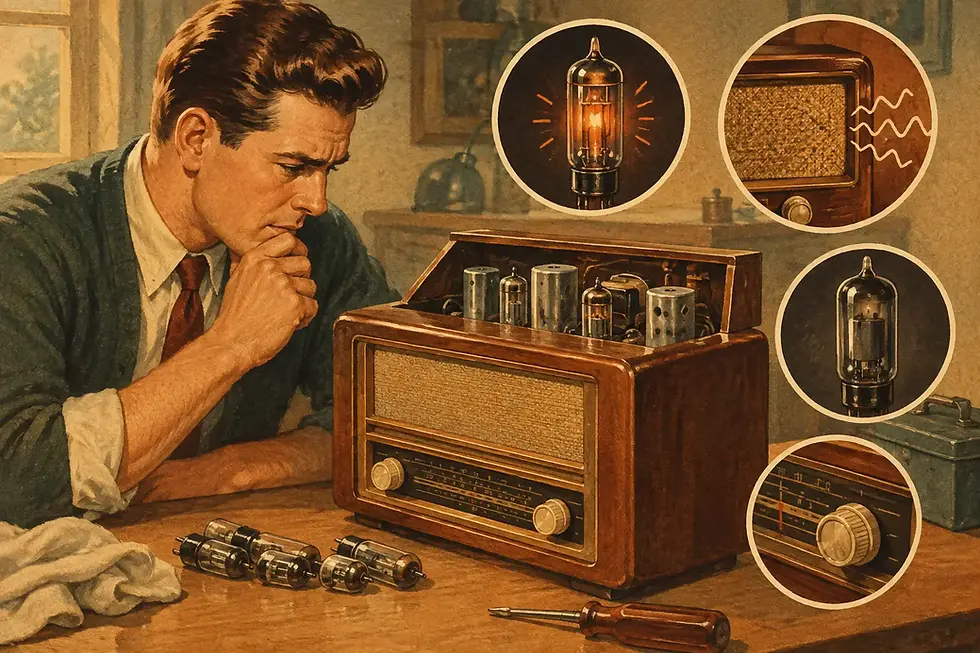
Consider a compact five-tube cathedral radio from the mid-1930s. Its wooden cabinet is structurally sound, with honest wear along the base and a small chip near one side of the arch. The original speaker is present, as are the dial scale, knobs, and chassis. When acquired, however, the set hums loudly, receives no stations, and has a power cord with brittle cloth insulation.
Those symptoms are common, but they do not point to one simple repair. A loud hum may come from failed filter capacitors. Silence may involve aged capacitors, weak tubes, damaged wiring, dirty tube sockets, a speaker problem, an open coil, or a fault in the power supply. In a radio approaching a century old, several concerns can exist at once.
The first step is careful documentation. Before any component is moved, the cabinet, chassis layout, dial assembly, wiring routes, tube complement, and markings should be photographed and noted. This is especially valuable when a previous owner has made repairs. Older work is not automatically wrong, but it needs to be evaluated rather than assumed safe or original.
Why Plugging It In Can Cause More Damage
A cathedral radio’s original paper and electrolytic capacitors were never expected to remain dependable for ninety years. Their insulation breaks down with age, even if the radio has spent decades untouched in a dry room. Applying full power can overheat a transformer, damage a rectifier tube, stress an output tube, or ruin parts that are much harder to replace than a capacitor.
The deteriorated power cord in this example is also an immediate concern. Cracked insulation and loose plugs are not cosmetic flaws. They create a shock and fire risk. The radio is inspected off power first, then brought up cautiously with appropriate test equipment after obvious hazards are addressed.
This measured approach is part of responsible antique radio service. These sets contain high voltages, including voltages that can remain stored after the radio is switched off. A collector with suitable training and equipment may enjoy this work, but an heirloom radio with sentimental or financial value is usually best placed with a specialist who understands tube-era safety practices.
Stabilizing the Chassis Without Erasing Its History
The repair begins with cleaning that is deliberate rather than aggressive. Dust, loose debris, and corrosion are removed from the chassis and controls without stripping aged metal or washing away identifying marks. The goal is not to make a 1930s chassis look factory-new. It is to stabilize it, make it safe to service, and preserve evidence of its age.
Failed capacitors are replaced with quality modern components selected for the correct values and voltage ratings. This is one of the most significant improvements in reliability and sound quality. Depending on the customer’s wishes and the radio’s condition, replacement parts may be installed discreetly to preserve the chassis’s original appearance. In some cases, original capacitor shells can be restuffed, placing modern internals inside the historic exterior.
That choice involves a real trade-off. Restuffing takes more labor and is appropriate when visual authenticity is a priority, particularly on a rare or highly collectible set. Carefully installed modern replacements may be the more practical choice for a common family radio intended to be enjoyed regularly. Either way, good workmanship should be neat, serviceable, and faithful to the radio’s electrical design.
The power cord is replaced with a safe, period-appropriate style where practical. Frayed rubber or cloth-covered wire does not become safe because it looks original. Safety components, wiring insulation, and secure strain relief deserve priority, especially on a set that will return to regular use.
Bringing the Sound Section Back to Life
Once the power supply has been stabilized, the radio’s tubes, resistors, speaker, coils, and controls can be evaluated methodically. Tubes are tested, but tube testing alone does not tell the whole story. A tube may test acceptably and still perform poorly in the circuit, while another may be weak yet serviceable. Decisions should be based on operating behavior, measured voltages, and the radio’s actual sound and reception.
In this example, the speaker cone has a small tear near its outer edge. Replacing the speaker would be quick, but it would also remove a significant original part and may alter the set’s character. A careful cone repair can often preserve the original field-coil speaker and its warm, period-correct voice. If the voice coil is damaged or the cone is too fragile to stabilize, replacement or professional reconing may be necessary. The right answer depends on condition, availability, and how the owner plans to use the radio.
Scratchy volume and tuning controls are cleaned and serviced where appropriate. Wiring with crumbling insulation is replaced selectively and routed to match the original path as closely as reasonable. Resistors that have drifted far beyond their intended values are replaced, particularly where they affect reliability, operating voltages, or audio performance.
Alignment Is Where Reception Becomes Musical Again
After the electrical repairs, the radio may play, but it is not necessarily performing as it should. Alignment is the precise adjustment of the radio’s intermediate-frequency and tuning circuits so stations appear at the correct place on the dial and the receiver delivers its best sensitivity and selectivity.
This work is performed with the proper instruments and the manufacturer’s service information whenever available. It is not a matter of turning adjustment screws until a station sounds louder. Incorrect alignment can reduce performance, distort dial tracking, or damage delicate coil forms and trimmer components.
For the cathedral radio in this example, alignment transforms a weak, wandering signal into clear local reception. The dial pointer is adjusted so the markings correspond sensibly to the stations received. The radio will not behave like a modern digital tuner, and atmospheric conditions will always influence AM listening. That is part of the experience. But it should tune cleanly, play without a heavy hum, and deliver the full, lively sound its original design intended.
Preserving the Cabinet’s Honest Character
The cabinet deserves the same restraint as the chassis. A cathedral radio’s wood arch, grille bars, toner finishes, and dial escutcheon are central to its identity. Over-sanding, heavy polyurethane, incorrect stain, or unnecessary veneer replacement can diminish both visual appeal and collector value.
In this case, the finish is cleaned and carefully revived rather than stripped. The small chip is stabilized and toned to reduce distraction without pretending it never happened. The original grille cloth is retained because it is complete and still structurally sound. If cloth is torn, badly stained, or missing, an era-appropriate pattern can restore the presentation while keeping the cabinet’s proportions and character intact.
This is where restoration becomes personal. Some owners want a radio that looks gently cared for, with its age visible. Others prefer a more polished presentation for a formal living room or collection display. Both approaches can be respectful when the work is reversible where possible and avoids sacrificing original material without good reason.
The Finished Radio Should Be Enjoyed, Not Feared
When the repaired set is finally powered on, the result is not merely a lit dial. It is the low glow of tubes behind the chassis, the soft rise of audio after warm-up, and the sound of distant programming arriving through a speaker that has carried voices for generations. A good restoration does not make an antique radio new. It gives it a sound, safe, and dignified second life.
At Regal Sound Design, that balance matters. Cathedral radios, tabletop sets, console radios, and tube audio pieces each require individual judgment, because their histories and conditions are never identical. A careful repair protects what can be preserved, replaces what must be made safe, and respects the reason the owner chose to save the piece in the first place.
If your cathedral radio has gone quiet, hums, smells hot, or has not been powered up in years, let its condition guide the next step. The most satisfying result is often not a flawless-looking artifact, but a thoughtfully restored radio that can once again fill a room with the sounds of yesterday.


Comments