


Why Vintage Tube Amplifiers Are Worth Restoring

A silent amplifier found in a family console, a dusty integrated amp from a basement shelf, or a cherished hi-fi piece that has begun to hum can feel like a lost part of the household. Tube amplifiers are more than old electronics. They carry the design, materials, and listening habits of an era when music systems were built to be repaired, admired, and kept for decades.
Restoring one properly is not simply a matter of making it power on. A thoughtful restoration respects the original circuit, addresses the parts that have aged beyond safe use, and protects the character that made the amplifier worth saving in the first place. For collectors, music lovers, and families caring for inherited equipment, that distinction matters.
What Makes Tube Amplifiers Different
A tube amplifier uses vacuum tubes to amplify an audio signal before sending it to speakers. Many designs from the 1940s through the 1960s were made with substantial transformers, serviceable chassis layouts, and components selected for long-term performance. These qualities help explain why so many units are still present in homes, collections, and estate sales today.
Their appeal is not only nostalgic. Well-designed tube equipment can deliver a full, dimensional sound that many listeners find engaging and natural. The exact character varies widely. A modest table radio amplifier, a console stereo, and a high-fidelity power amplifier each have different circuitry, output stages, and expectations for performance. There is no single “tube sound,” and no honest restoration should promise that every piece will behave like a modern audiophile component.
What a good restoration can do is bring an amplifier back to stable, safe, enjoyable operation while preserving the qualities that belong to its original design. That may mean a warm, gentle presentation from a small postwar radio chassis or clean, commanding sound from a well-built hi-fi amplifier.
Age Changes More Than the Sound
An amplifier can look remarkably clean and still require careful service. Time affects the electrical parts hidden beneath the chassis, often long before obvious exterior damage appears. Capacitors dry out or become electrically leaky. Resistors drift from their original values. Tube sockets, controls, switches, and connectors can oxidize. Power cords may no longer provide appropriate insulation or grounding.
Some of these problems announce themselves with hum, crackling, weak volume, distorted sound, overheating, or a blown fuse. Others are quieter. An amplifier may play for a few minutes and seem acceptable while placing unnecessary strain on its power transformer, output transformer, rectifier tube, or other hard-to-replace parts.
This is why “it still works” should not always be treated as a reason to leave vintage equipment untouched. Originality is valuable, but so is preventing damage to the very components that give an antique amplifier its identity. A careful technician evaluates which original materials can remain in service and which have become a risk to reliability or safety.
Restoration Is Not the Same as a Quick Repair
A quick repair solves the symptom that brought the unit to the bench. Restoration looks at the condition of the entire amplifier and its likely future use. If a unit hums, replacing one failed part may quiet it temporarily. But if related capacitors, resistors, wiring, and connections are similarly aged, the underlying concern may remain.
The right scope depends on the equipment and the owner’s goals. A rare, highly original collector piece may call for a conservative approach with close attention to historical appearance. A daily-use tube receiver may benefit from more comprehensive electrical renewal so it can be enjoyed with confidence. An heirloom console may need both: respectful preservation of its visible features and dependable service behind the scenes.
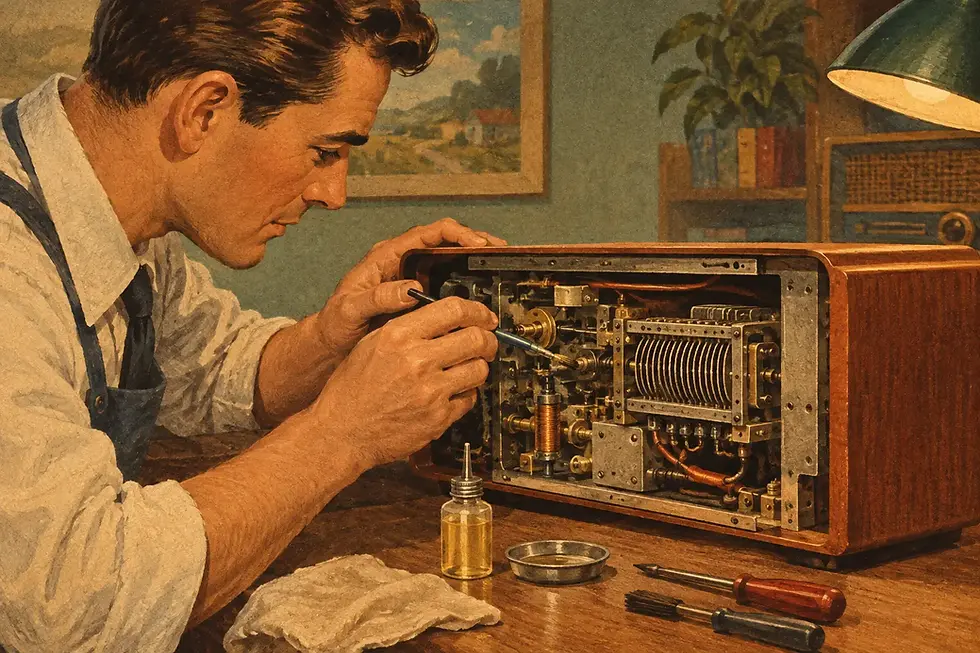
A proper evaluation usually begins with the condition of the cabinet and chassis, signs of prior work, tube inventory, transformer health, wiring condition, and the behavior of the amplifier under controlled testing. From there, restoration can address aged capacitors, out-of-tolerance resistors, worn controls, weak tubes, damaged cords, and alignment or bias concerns where applicable.
The goal is not to replace every old part merely because it is old. It is to make informed decisions that protect performance, safety, and historical integrity.
Original Parts and Honest Choices
Owners often ask whether replacing parts will reduce an amplifier’s value. The answer depends on the component, the rarity of the unit, the quality of the work, and whether the replacement is necessary. A leaking paper capacitor buried below the chassis is rarely a virtue if it threatens expensive transformers or causes poor performance. Replacing it with an appropriate modern part is often responsible preservation.
Visible components require more judgment. On certain collectible amplifiers and radios, retaining the original appearance beneath the chassis may be especially important. In some cases, a restorer can preserve the look of a vintage component while improving electrical reliability. In others, clear, neat replacement work is the more sensible and serviceable choice.
What should never be compromised is craftsmanship. Sloppy soldering, unnecessary modifications, mismatched parts, or wiring changes that ignore the original circuit can diminish both value and reliability. Good restoration work should look intentional, be electrically sound, and leave future service technicians able to understand what was done.
The Tubes Matter, but They Are Not Always the Problem
Vacuum tubes receive most of the attention because they are visible, distinctive, and easy to associate with a vintage amplifier’s sound. They do wear over time, and a weak or noisy tube can certainly cause trouble. Yet tubes are often blamed for faults caused by aging capacitors, dirty contacts, poor solder joints, or incorrect operating voltages.
Testing tubes is useful, but it is only one part of diagnosis. A tube can test reasonably well and still behave poorly in a particular circuit. Conversely, replacing every tube without addressing the amplifier’s underlying electrical condition can be an expensive way to miss the real issue.
When replacement tubes are needed, the best choice depends on availability, circuit requirements, and how the equipment will be used. Original branded tubes may be desirable to collectors, while carefully selected tested replacements can be the practical answer for a listening amplifier. The important thing is proper operation, not chasing a label for its own sake.
Safety Is Part of Preservation
Vintage tube equipment contains high voltages that can remain present even after it has been unplugged. These are not casual weekend projects for someone without the right experience, test equipment, and understanding of tube-era circuits. A seemingly simple power-up can damage irreplaceable components or create a serious shock hazard.
This is particularly true for equipment that has sat unused for years, has unknown repair history, or shows signs of heat damage, corrosion, rodent exposure, or deteriorated wiring. Bringing it up slowly and evaluating its condition methodically can prevent a minor issue from becoming a major loss.
Owners can still help protect their equipment before service. Keep the amplifier dry, avoid repeated attempts to power it on if it hums or smells hot, and do not store it where temperature swings and moisture can accelerate deterioration. If it must be transported, remove loose tubes only when they can be labeled and packed carefully, and support the chassis rather than lifting by delicate controls or knobs.
Choosing Restoration for the Right Reason
Not every old amplifier needs to become a daily driver, and not every restoration needs to pursue showroom perfection. Some pieces are best preserved as historically intact examples. Others deserve to return to regular listening duty. The right decision starts with what the amplifier means to you.
Perhaps it is the component that played records in your parents’ living room. Perhaps it is a flea-market find with a handsome chassis and real potential. Perhaps it is a respected hi-fi amplifier whose sound has been absent from your system for too long. In each case, careful restoration can honor the object without pretending it is something it never was.
At Regal Sound Design, the work begins with that respect: treating vintage audio equipment as both a functional machine and a piece of history. A restored amplifier should not erase its age. It should allow its voice to be heard again, with the care and confidence it deserves.

Comments