


Tube Amplifier Restoration Review That Matters

A meaningful tube amplifier restoration review begins before the first tube glows. It begins with the object itself: a handsome integrated amplifier found in an estate, a cherished monoblock pair that once filled a family living room, or a preamp that has waited quietly on a shelf for decades. These components carry more than music. They represent an era when audio equipment was built to be serviced, understood, and enjoyed for a lifetime.
For that reason, a proper restoration cannot be judged only by whether an amplifier powers on. A lighted pilot lamp and sound from both speakers are encouraging, but they do not confirm safe operation, stable performance, or faithful sound. The best restoration work respects the original design while addressing the age-related failures that can place valuable transformers, tubes, speakers, and listeners at risk.
What a Tube Amplifier Restoration Review Should Examine
A thoughtful review starts with condition, originality, and intended use. An amplifier that will be played for a few hours each month needs a different conversation than one that will anchor a daily listening system. Likewise, a rare early component with unusual parts deserves a more preservation-minded approach than a common model whose value lies chiefly in reliable musical performance.
The cabinet, faceplate, lettering, knobs, chassis, transformers, tube shields, and underside wiring all tell part of the story. Surface wear is not automatically a flaw to erase. A small patina mark or an aged finish may be honest evidence of a component's life. Heavy polishing, repainting, or replacement hardware can make a vintage amplifier look newer while making it less authentic. Restoration should improve condition where appropriate, not turn history into a costume.
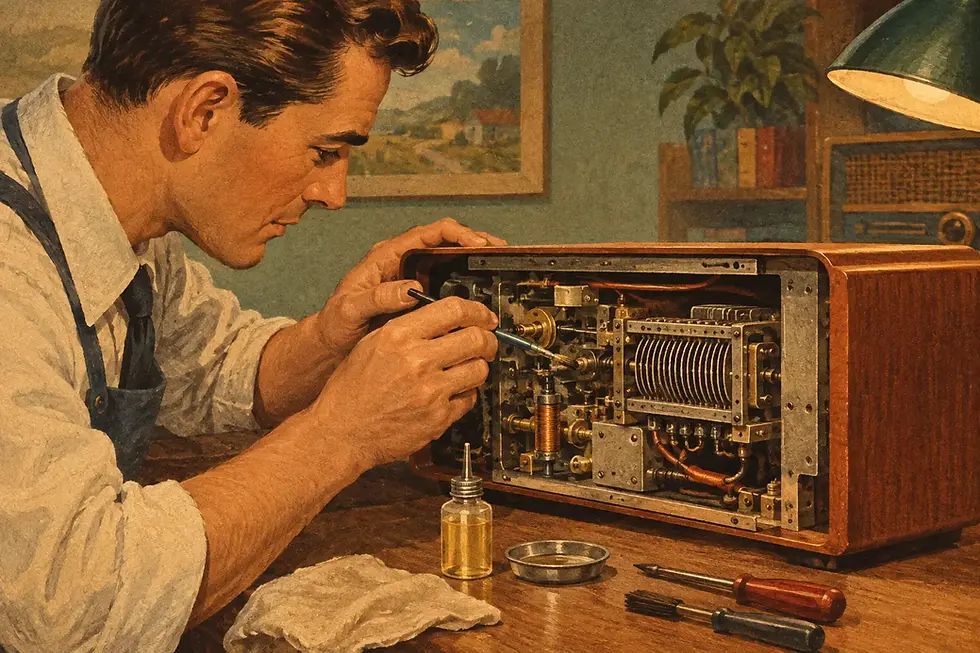
Under the chassis, the focus shifts to safety and electrical health. Paper and electrolytic capacitors often degrade with age, even when the amplifier still plays. Leaky capacitors can cause hum, weak bass, distorted output, excessive current draw, or damage to costly power and output transformers. Old resistors may drift from their intended values, and brittle insulation, frayed line cords, tired switches, and corroded contacts can create problems that are not apparent during a brief test.
A review should also consider whether prior repair work was careful. Vintage equipment sometimes arrives with mismatched parts, poorly routed wiring, oversized replacements, or quick fixes that obscured an original fault. The goal is not to criticize every earlier repair. Many amplifiers survived because someone made them usable. Still, a restoration specialist needs to identify work that affects reliability, safety, serviceability, or the original circuit's performance.
Sound Quality Is Only Part of the Result
Tube amplifiers are valued for their texture, dimensionality, and ability to make familiar recordings feel present again. Yet a restoration should not force a particular idea of “tube sound” onto every amplifier. Some classic designs are warm and rounded; others are open, detailed, and surprisingly neutral. The proper result is an amplifier operating as its designers intended, not one artificially voiced to match a trend.
After the necessary electrical work, listening tests reveal a great deal. A restored unit should be evaluated for hum, channel balance, intermittent noise, distortion, weak output, unstable controls, and proper response as it warms up. Stereo amplifiers also deserve checks for equal performance between channels. On a mono amplifier, the question is whether it delivers clean, confident sound at reasonable volume without strain or excessive heat.
Tube testing matters, but it is only one part of the picture. A tube can test strongly and still behave poorly in a particular circuit. Conversely, an older tube may remain useful if it performs quietly and within acceptable operating limits. Replacing every original tube automatically is rarely the most thoughtful choice. Good original tubes can be part of an amplifier's history and character, while weak, noisy, or unsafe tubes should be replaced with suitable alternatives.
Bias and operating voltages are equally important. Output tubes must be running within the range intended by the circuit, especially in amplifiers where improper bias can shorten tube life or overstress transformers. This is the kind of careful, measured work that separates a real restoration from a simple power-up test.
The Originality Question
Owners often ask whether every replaced component should be an exact visual match for the original. The honest answer is that it depends. For a museum-level piece or a highly collectible amplifier, appearance beneath the chassis may matter greatly. For an amplifier intended for regular listening, modern high-quality components may offer better reliability while remaining discreetly installed and electrically appropriate.
What should not be compromised is the circuit's integrity. Substitutions must have suitable electrical ratings and be chosen with an understanding of how the amplifier operates. A part that physically fits is not necessarily the right part. Where original components are retained for appearance or historical value, that decision should be made knowingly, with a clear understanding of the trade-off between originality and dependable use.
Safety Deserves a Place in Every Review
Tube equipment uses voltages that can remain dangerous even after it has been unplugged. This is not a category for casual probing or online guesswork. A vintage amplifier that appears dead may have a simple fault, but it may also have damaged wiring, shorted parts, or stored electrical charge.
A professional restoration review considers the power cord, grounding approach, fuse protection, transformer condition, and the overall safety of the unit before prolonged operation. Some changes are sensible for equipment that will be used regularly, while others may be inappropriate for a highly original collectible. There is no universal checklist that fits every amplifier from the 1920s through the 1960s. Careful service is always specific to the piece in front of the technician.
This is also why a slow initial power-up and monitored testing are valuable. Bringing a long-dormant amplifier directly to full power can turn a repairable component into a much larger project. Patience protects the amplifier's irreplaceable parts and gives the technician time to locate faults before they create secondary damage.
Questions Worth Asking Before You Approve Work
The most reassuring restoration experience is transparent. Before authorizing service, ask what is known about the amplifier's present condition, what work is recommended for safe operation, and what work is optional. You should also understand whether the goal is careful preservation, reliable daily use, or a balance of both.
Ask how original cosmetic details and usable tubes will be handled. Ask whether noisy controls, sockets, switches, and connectors will be cleaned and evaluated rather than ignored. If the amplifier is paired with a matching tuner, preamplifier, or turntable, mention that as well. Vintage systems were often designed as a family, and their interaction can affect the final listening experience.
At Regal Sound Design, restoration is approached as both technical repair and responsible stewardship. A tube amplifier is not simply old equipment waiting for replacement parts. It is a piece of audio history with its own circuit, materials, scars, and voice. Careful handling, clear communication, and a 30-day warranty on repaired audio pieces help owners feel confident placing a treasured component back into service.
When Restoration Is the Right Choice
Restoration is especially worthwhile when an amplifier has sentimental value, strong build quality, rare design features, or a sound that modern equipment has not replaced for its owner. It can also make practical sense when a well-made vintage component needs predictable service rather than another cycle of temporary fixes.
There are times when the work may exceed the market value of the amplifier, particularly with heavily damaged or entry-level models. That does not automatically make restoration the wrong decision. Market value and personal value are different measures. A small tube amp that belonged to a parent may deserve care that no price guide can explain.
The lasting reward is not merely hearing an old amplifier make noise again. It is hearing it operate with confidence, preserving the details that make it yours, and knowing that the next record played through it has been given the attention its history deserves.

Comments