


Vintage Receiver Repair Service Done Right

A receiver that has gone silent is rarely just another broken appliance. It may be the centerpiece of a first hi-fi system, a family console that once filled the living room, or a carefully chosen piece of tube-era engineering. A proper vintage receiver repair service respects both sides of that story: the circuitry that must work safely and the original character that deserves to remain intact.
Vintage receivers from the 1920s through the 1960s were built to be serviced, but age changes the work required. Heat, dust, dried components, fragile wiring, and decades of well-meaning repairs can all affect performance. The goal is not simply to make a dial light up or produce sound for a few minutes. It is to return the receiver to dependable operation while preserving the features that make it worth keeping.
Why Vintage Receivers Need Specialized Repair
A tube receiver is not a modern stereo component with older styling. Its power supply, signal path, tuning section, output stage, and controls operate by principles that demand familiarity with high-voltage tube equipment. Even when unplugged, some components can retain a dangerous electrical charge. A receiver that appears simple from the outside may contain delicate coils, aging insulation, and proprietary parts that cannot be treated casually.
The symptoms can also be misleading. A faint hum may point to tired filter capacitors, but it can also reveal grounding trouble or an earlier modification. Weak reception may stem from a worn tube, a dirty band switch, an antenna issue, or an alignment problem. Distortion can originate in the audio section, the speaker, the power supply, or more than one area at once.
That is why a specialist begins with diagnosis rather than assumptions. Replacing parts without understanding the circuit can create new problems, alter the receiver's sound, or damage parts that cannot be easily replaced. A careful repair process considers how the unit was designed to perform and what it has experienced over the years.
What a Vintage Receiver Repair Service Should Include
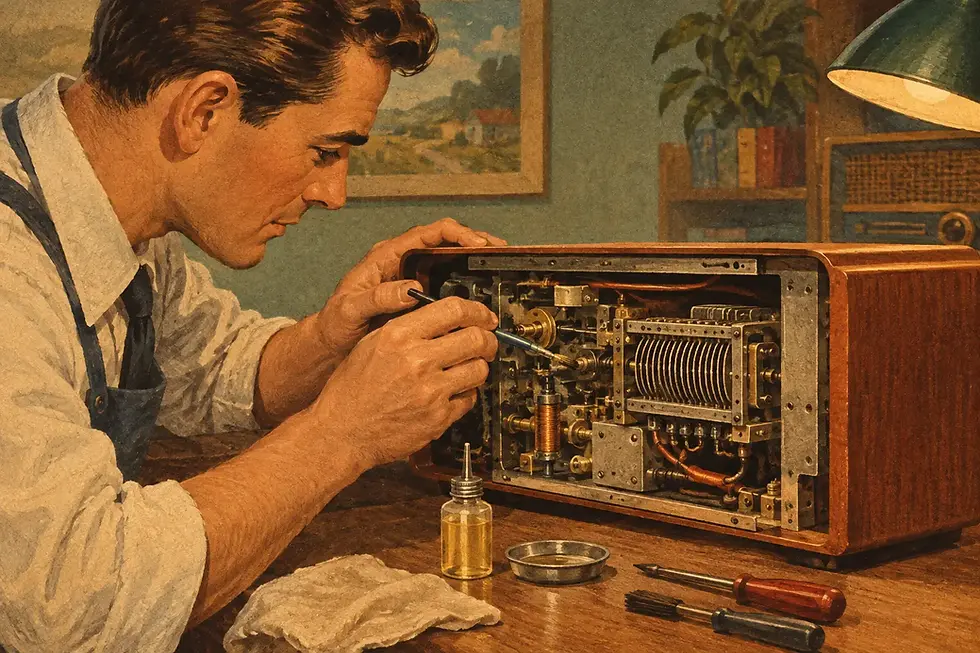
The first stage is a thorough visual and electrical evaluation. A technician checks the cabinet condition, chassis, tubes, transformers, controls, dial mechanism, wiring, speaker, and signs of previous work. This early inspection helps identify immediate safety concerns, such as a brittle power cord, shorted components, damaged insulation, or evidence of overheating.
From there, the receiver should be tested methodically. Power is introduced carefully, not rushed through a wall outlet after decades of storage. Voltage readings, tube performance, hum level, signal response, and control operation help reveal what the receiver needs. For an AM/FM tuner or receiver, proper alignment is often part of the work once the underlying circuitry is stable. Alignment restores accurate tuning and can bring back the sensitivity and clarity that made these sets impressive in their day.
A quality service also addresses the mechanical details that shape daily enjoyment. Noisy volume controls, stiff tuning mechanisms, slipping dial cords, weak indicator lamps, and loose hardware may not be the central electrical failure, but they affect how the receiver feels to use. The best restoration work brings technical care to these smaller details without making the piece look newly manufactured.
For tube receivers, the final stage is extended listening and performance testing. The receiver should be evaluated at normal operating levels, not merely declared repaired because it passes a brief bench test. Heat can expose faults that were not apparent at startup. A stable, quiet receiver after proper testing offers far more confidence than one that simply powers on.
Preservation Matters as Much as Performance
Every vintage receiver calls for a different level of intervention. A rare, highly original piece may benefit from conservative restoration that retains period-correct appearance wherever practical. A receiver intended for regular listening may need more extensive reliability work, especially in the power supply and audio circuits. Neither choice is automatically better. It depends on the equipment, its rarity, its condition, and whether it will be displayed, collected, or played every evening.
Preservation-minded repair means retaining original parts when they remain safe and functional, protecting labels and finishes, and avoiding unnecessary cosmetic changes. It also means documenting meaningful changes when replacement is necessary. Components do age, and some need replacement for the receiver to operate safely and reliably. But a good technician does not erase the history of the set in the process.
This approach matters for everything from a postwar tabletop radio to a substantial wood console, tube tuner, or early stereo receiver. A cracked dial scale, fragile pushbutton assembly, or unobtainable transformer can change the plan entirely. The work should be guided by patience and judgment rather than a one-size-fits-all checklist.
Signs Your Receiver Is Ready for Service
A receiver does not have to be completely silent to need professional attention. Many owners live with gradual decline because the change happens slowly: a little more hum, less volume, drifting stations, or intermittent sound from one channel. Those are often early warnings that deserve attention before a small problem becomes a costly failure.
Service is especially wise if the receiver has been stored for years, has an original power cord, produces a burning smell, blows fuses, crackles heavily, or develops excessive heat. Do not continue powering a unit that smokes, arcs, or makes unusual transformer noise. Turning it off promptly can prevent further damage to scarce components.
It is also sensible to have a newly acquired estate, flea-market, or auction find inspected before regular use. A beautiful cabinet and glowing tubes do not confirm that the set is electrically safe. Some receivers have been altered over decades by previous owners, and those changes are not always visible until the chassis is examined.
Questions to Ask Before Sending a Receiver Out
Before choosing a repair provider, ask whether they regularly work on tube-era receivers rather than general consumer electronics. Experience with tube amplifiers alone is valuable, but radio-frequency sections, FM multiplex circuits, dial mechanisms, and vintage speaker systems add their own challenges.
Ask how the equipment will be evaluated, whether the shop can explain recommended work before proceeding, and how the unit will be handled during service. Clear communication is part of careful restoration. You should understand whether the recommendation is a safety repair, a performance restoration, a cosmetic improvement, or a combination of these.
It is also reasonable to ask about testing and warranty coverage. Regal Sound Design stands behind repaired audio pieces with a 30-day warranty, reflecting the care taken to test work before a treasured receiver returns home. A warranty does not make an antique component new, but it does show that the repair is treated as professional service rather than a quick fix.
Preparing a Vintage Receiver for Repair
Take a few photographs before packing or delivering the unit, particularly if the cabinet has existing marks or delicate trim. Include any loose knobs, special antenna parts, manuals, or information about when the issue began. Details such as “the FM band fades after 20 minutes” or “the left channel cuts out when the balance control moves” can shorten diagnosis considerably.
Avoid attempting repeated power-ups to see whether the receiver will suddenly recover. Likewise, do not spray cleaners into controls or pull tubes at random unless you are experienced with the equipment. A small amount of restraint protects a receiver's original parts and gives the technician a clearer picture of its condition.
When the warm glow returns and a familiar station comes through cleanly, the result is more than a repaired circuit. It is a piece of craftsmanship given another useful chapter. Treat that receiver with the same patience it took to build, preserve, and restore it, and it can keep carrying the sounds of yesterday into the years ahead.


Comments